A solar system should be designed around your roof, electricity use and future plans – not simply around the lowest monthly payment. The right solar panel finance options can make on-site generation and battery storage achievable sooner, but the cheapest-looking route is not always the best value over the life of the system.
For homeowners, landlords and businesses, the key question is how the funding arrangement affects ownership, savings, flexibility and risk. A clear survey and detailed system design give you the figures needed to make that decision with confidence.
Start with the lifetime value, not the deposit
Solar panels typically work for decades, so it helps to compare finance over the same long view. A cash purchase may involve more upfront cost but no interest. A loan may preserve capital for other priorities, while a lease or power purchase agreement can reduce initial spend but may limit some of the financial upside.
Before comparing offers, establish a realistic forecast for annual generation, the proportion of solar electricity you expect to use on site, export income where applicable, and likely electricity-price savings. For a commercial property, this should also account for half-hourly consumption patterns, operating hours and planned changes such as electric vehicle charging or additional machinery.
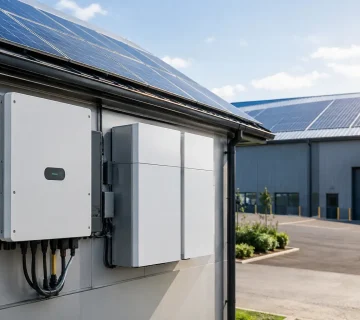
Battery storage can change the calculation. It may increase the initial cost, but it can allow more daytime generation to be used in the evening, reduce grid imports at higher-cost periods and provide greater control over how power is used. Whether that extra investment pays back well depends on your load profile rather than a one-size-fits-all rule.
Solar panel finance options at a glance
Paying cash
Paying upfront is the simplest route. You own the equipment from commissioning, receive the full benefit of avoided electricity purchases and can choose how to maintain, upgrade or expand the system later. There are no finance charges and no lender requirements tied to the property.
This approach is often attractive where the available capital is not needed for higher-priority work. For a business, however, tying up cash in a solar project must be weighed against working-capital needs. For a homeowner, it is sensible to retain an emergency reserve rather than committing every available pound to the installation.
Unsecured personal loans and green loans
An unsecured loan spreads the cost over a fixed term without using the property as security. This can suit homeowners who want to own their system immediately but would rather pay monthly. Some lenders market green or home-improvement loans specifically for energy upgrades, although eligibility, rates and terms vary.
The central comparison is between the total interest payable and the expected electricity savings over the repayment period. A low monthly payment over a long term can look appealing, but may increase the total cost substantially. Check whether early repayment is permitted and whether there are fees for doing so. A fixed rate also offers certainty when household budgets are under pressure.
Secured borrowing or remortgaging
Some property owners fund larger improvements through a further advance, remortgage or other secured borrowing. The interest rate may be lower than an unsecured loan, but the repayment term can be much longer. That can make monthly payments manageable while increasing the overall interest paid.
This route requires particular care because the borrowing is linked to the property. Consider whether the solar investment is being financed over a sensible period, whether you expect to move soon, and how the arrangement may affect future mortgage applications. Independent financial advice can be valuable where a remortgage is under consideration.
Commercial loans and asset finance
For businesses, a commercial loan or asset-finance agreement can preserve cash for stock, payroll, expansion or other operational needs. Repayments can be structured around the organisation’s expected cash flow, and a professionally engineered system can be assessed as a long-term energy-cost reduction rather than just a capital expense.
Terms differ widely. Some arrangements transfer ownership at the outset; others provide a route to ownership at the end of the agreement. Ask for the full cost, payment schedule, security requirements and end-of-term position in writing. It is also wise to involve your accountant early, as tax treatment, capital allowances and VAT considerations depend on the business and the agreement.
Leases and power purchase agreements
Leases and power purchase agreements, often called PPAs, are more common for commercial sites and larger multi-property projects. Under a lease, a provider may install equipment in return for regular payments. Under a PPA, the provider may own and maintain the system while the site buys the electricity generated at an agreed rate.
The advantage is lower upfront expenditure and, in some cases, less responsibility for maintenance and performance risk. The trade-off is that the property owner may not receive the full saving available from the solar generation, and the agreement can affect property transactions or tenant arrangements. Contract length, price escalation, roof-access rights, insurance, maintenance responsibilities and removal provisions all deserve close attention.
For landlords and managing agents, clarity is especially important. The agreement should set out who benefits from the electricity, who receives export payments, and what happens if a tenant changes or the building is sold.
Funding support and incentives: check what applies now
Government support, local programmes and tax arrangements can change, so they should be treated as part of the financial picture, not the entire reason for a project. In the UK, eligible homeowners may benefit from reduced VAT on certain energy-saving materials, while businesses may have access to different tax reliefs or local funding opportunities.
Export payments can also contribute to returns when surplus electricity is sent to the grid. The rate and terms are supplier-specific, and generation should not be sized solely around exporting power. In most cases, using more of your own solar electricity delivers stronger value than exporting it, particularly when a battery, smart controls or daytime demand can improve self-consumption.
An installer should be able to explain the assumptions in a proposal clearly: expected generation, expected self-use, export estimates, electricity-price assumptions and the warranty cover included. If a forecast seems unusually optimistic, ask what it is based on.
Questions to ask before signing a finance agreement
Finance should support a well-designed system, not compensate for an unclear proposal. Request a written quotation that separates system cost from finance cost and identifies the panels, inverter, battery if included, mounting equipment, electrical work and monitoring.
You should also confirm who owns the system at each stage, what warranties apply, and who is responsible if equipment needs repair. For leased systems and PPAs, ask how roof works, insurance claims, property sales and system removal are handled. For loans, confirm the annual percentage rate, total repayable amount, missed-payment consequences and early-settlement terms.
For a commercial installation, ask for a generation and performance rationale that reflects your actual site. A restaurant, warehouse, hotel and food manufacturer can have very different demand patterns even when their annual electricity use is similar. The strongest proposal connects design and finance to how the building genuinely operates.
Choose flexibility as well as affordability
The best option depends on what you need the project to achieve. A homeowner planning to stay in their property for many years may place the highest value on outright ownership. A growing business may prefer to protect cash flow. A landlord may prioritise clear responsibilities and a structure that works across changing tenancies.
Whatever route you choose, do not let finance distract from installation quality. Accurate design, safe electrical work, appropriate permissions, commissioning, monitoring and responsive aftercare all protect the performance your repayments or investment rely on. Shard Solar can assess the property, explain the practical choices and provide a detailed quotation so the funding decision is based on a system built for your energy needs – not a generic estimate.
A good solar investment should leave you with more control over future energy costs, not a contract you struggle to understand. Take the time to compare the total commitment, keep the assumptions realistic and choose the arrangement that lets your property benefit from clean power for years to come.