A battery can make solar power useful long after the panels stop producing, but the way it connects to your system matters. In the AC coupled versus DC coupled decision, the best answer depends less on a single efficiency figure and more on whether you already have solar, how you use electricity and what you need the system to do during a power cut.
For a homeowner, that may mean choosing the simplest route to add storage to an existing array. For a business, it may mean engineering a system that captures more midday generation, reduces costly peak demand and works around operational loads. Both approaches can lower grid imports and increase the value of your solar generation. They simply move electricity through the system differently.
What AC and DC coupling actually mean
Solar panels produce direct current, or DC electricity. Most buildings use alternating current, or AC electricity, so an inverter converts the power before it supplies lights, appliances, machinery or the grid.
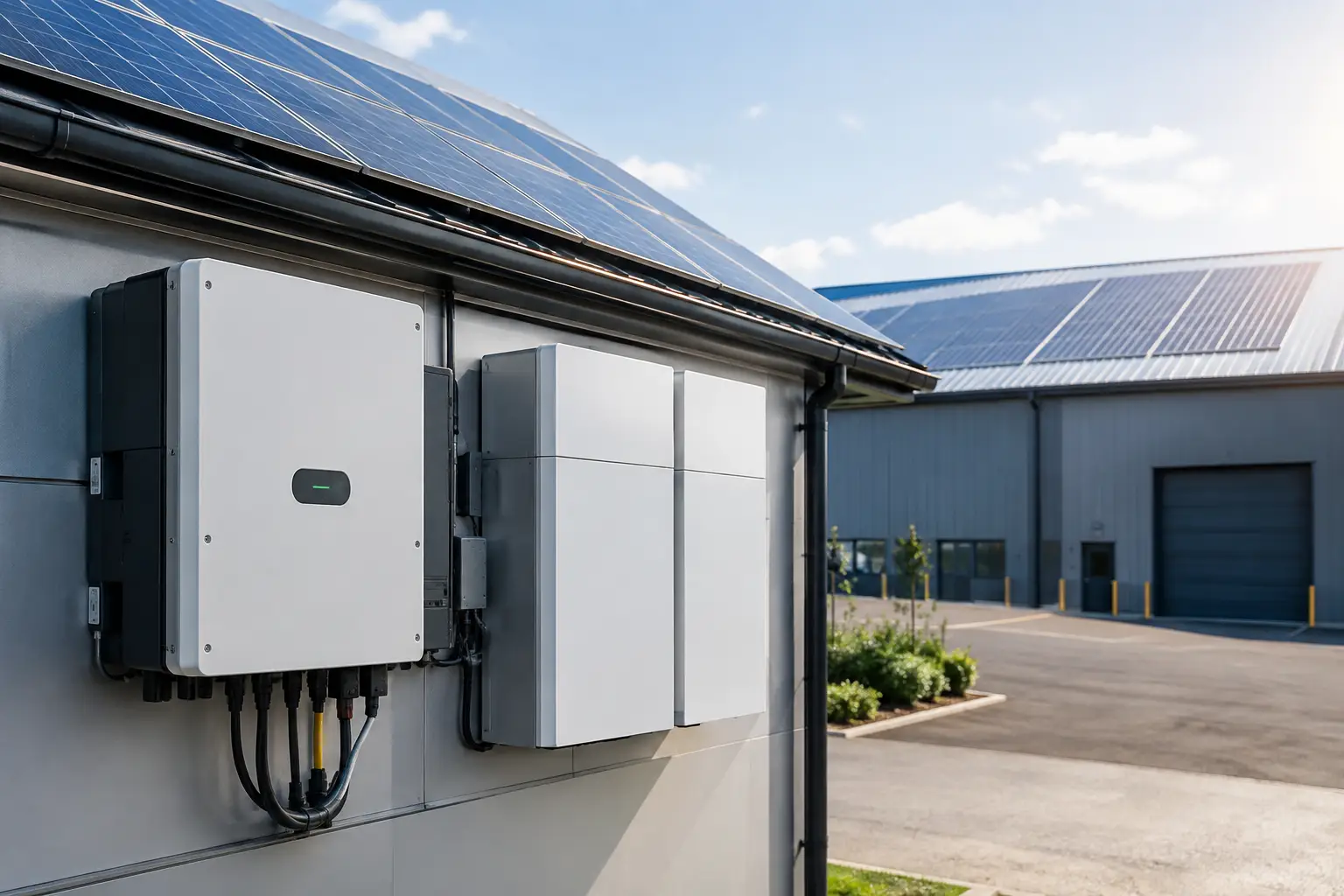
A DC-coupled battery is connected on the DC side of the solar system, before conversion to AC. Solar generation can therefore charge the battery directly. An AC-coupled battery has its own battery inverter and connects on the AC side, usually through the property’s consumer unit. In this arrangement, solar electricity is converted to AC by the solar inverter, then converted back to DC to charge the battery.
That difference sounds small, but it affects conversion losses, equipment choice, expansion options and installation complexity. It also explains why a battery retrofit often points towards AC coupling, while a new solar-and-storage installation often suits DC coupling.
AC coupled versus DC coupled for existing solar
An AC-coupled battery is commonly the practical choice when a property already has a working solar PV array. The existing solar inverter can remain in place, while a separate battery inverter manages charging and discharging. This avoids replacing equipment that still has useful life and can reduce disruption during installation.
The battery monitors export and household demand. When the panels are generating more than the building needs, it directs surplus electricity into storage. Later, it discharges to support evening consumption or periods when electricity from the grid is more expensive, if the system is set up for time-of-use tariffs.
This flexibility is valuable for many homes, landlords and commercial sites. A well-designed AC-coupled system can also make it easier to increase battery capacity in future, subject to the equipment specification and the property’s electrical supply.
The trade-off is efficiency. To store solar electricity, power may pass through several conversions: DC from the panels to AC through the PV inverter, then AC back to DC for the battery. When stored energy is used, it is converted again for building use. Each conversion loses a small amount of energy.
That does not make AC coupling a poor option. If it preserves a good existing PV system and allows a battery to be fitted without a major redesign, the additional flexibility can outweigh the conversion losses. The figures that matter are the expected usable battery capacity, round-trip efficiency, charging and discharging power, and how closely the design matches real consumption.
When AC coupling is likely to fit
AC coupling is often well suited to a solar retrofit, particularly where the current inverter is modern, appropriately sized and supported by its manufacturer. It can also suit properties with a separate battery project in mind, rather than a full solar replacement.
However, compatibility must be checked rather than assumed. Export limitation settings, phase arrangement, consumer-unit capacity, inverter communications and the local Distribution Network Operator requirements all influence the final design. For larger commercial sites, protection settings and load profiles require particular care.
When DC-coupled storage makes more sense
With DC coupling, solar panels and battery storage work through an integrated hybrid inverter or a dedicated DC battery inverter arrangement. Solar power can charge the battery before it is converted for use in the building. Fewer conversion stages generally mean more of the generation reaches the battery.
This is a strong option for new solar installations and for properties where the existing inverter is due for replacement. Designing the panels, inverter and battery as one system gives the installer more control over performance from the outset. It can also reduce the amount of separate hardware on the wall.
DC coupling can be particularly attractive where a property regularly produces significant surplus during the day and uses much of its electricity after sunset. Homes with electric cooking, heat pumps or EV charging may see this pattern, as can businesses with evening operations. The benefit still depends on the battery being correctly sized. An oversized battery that rarely fills is not automatically better value.
There are limits to consider. A DC-coupled battery usually depends more closely on the chosen hybrid inverter and its battery ecosystem. Adding capacity later may be possible, but options can be more constrained than with some AC-coupled products. If either the inverter or battery needs replacing in the future, system compatibility is an important consideration.
Solar clipping and inverter size
DC-coupled designs can sometimes capture energy that would otherwise be limited by the AC output rating of the solar inverter. This can be useful where the panel array has a higher DC capacity than the inverter’s AC rating, a common design approach for improving generation across lower-light periods.
It is not a reason to oversize panels without analysis. The value depends on roof orientation, shading, seasonal production, battery charging limits and export arrangements. Good system design starts with measured or estimated generation and half-hourly demand data where available, not a generic equipment package.
Compare the practical differences
| Consideration | AC-coupled battery | DC-coupled battery | |—|—|—| | Best starting point | Existing solar PV systems | New solar and battery systems | | Inverters | Separate solar and battery inverters | Usually a hybrid inverter managing both | | Solar-to-battery efficiency | More conversion steps | Usually fewer conversion steps | | Future changes | Often flexible for retrofits and additions | May be more dependent on one product ecosystem | | Installation approach | Can retain an existing PV inverter | Usually designed as one integrated system |
These are useful tendencies, not fixed rules. A high-quality AC-coupled solution may be the sensible financial choice for an established solar installation. Equally, a DC-coupled system may be preferable on a refurbishment project where electrical work is already planned.
Backup power is a separate design decision
A battery does not automatically keep a building powered during a grid outage. Standard solar inverters normally switch off when the grid fails to protect engineers working on the network. To provide backup power, the system needs suitable hardware, isolation arrangements and a properly designed backup circuit.
Some systems can support selected essential loads, such as lighting, refrigeration, internet equipment and sockets. Others can be engineered for broader whole-property backup, provided battery power, inverter output and starting currents have been assessed. Heating systems, pumps, commercial refrigeration and three-phase equipment can place very different demands on a battery.
Whether a battery is AC or DC coupled does not, by itself, determine backup quality. The inverter’s backup capability, changeover equipment and agreed load plan do. Discussing this early prevents a common disappointment: a sizeable battery that reduces bills but cannot power the circuits that matter during an outage.
Choose around your energy habits, not just battery size
The right configuration begins with a property survey and an honest picture of demand. Look at when the building imports electricity, how much solar generation is likely to be exported, whether an EV or heat pump is planned, and whether tariff shifting will form part of the savings case.
For commercial customers, interval data can reveal short but expensive demand peaks that a battery may help reduce. For households, evening usage is often the key question. A family that is out during the day, returns home after 6 pm and charges an EV overnight has a different requirement from someone working from home and using most solar generation as it is produced.
Budget matters too, but the lowest equipment cost is not always the lowest lifetime cost. Consider warranty terms, usable capacity rather than headline capacity, expected cycling, monitoring, maintenance access and the quality of commissioning. A system should show clearly what it is generating, storing, exporting and importing, so its performance can be understood over time.
Shard Solar assesses the roof, electrical infrastructure and consumption profile before recommending equipment. This gives each project a clearer basis for deciding whether retaining an existing inverter, installing a hybrid inverter or planning for backup power will deliver the best practical result.
A battery should fit the way your property lives or operates. When the connection method, storage capacity and controls are designed around that reality, solar becomes more than daytime generation: it becomes a dependable source of cleaner, better-timed power.