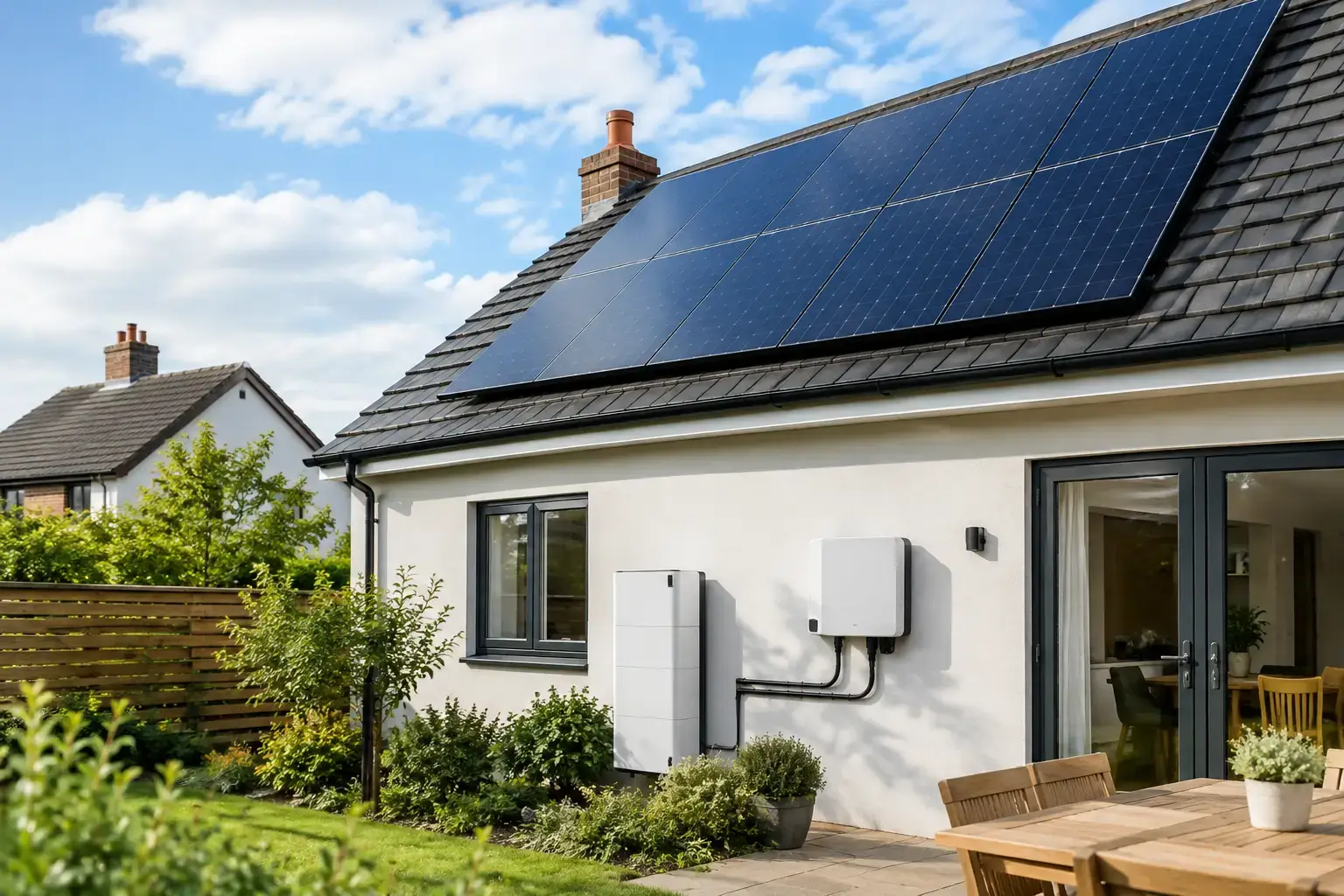
A battery does more than hold spare solar electricity for the evening. It changes when your property buys power from the grid, how it responds to high tariffs and, where backup equipment is specified, how critical circuits can keep running during an outage. When comparing AC coupled versus DC batteries, the right answer depends less on a headline specification and more on whether you are adding storage to an existing solar array or designing a complete system from the start.
The terminology can be misleading. Battery cells store direct current (DC) in both cases. The difference is where the battery connects to the solar system and how often electricity is converted between DC and alternating current (AC) before it is used.
What is an AC-coupled battery?
An AC-coupled battery connects on the AC side of a property’s electrical system. Your existing solar inverter converts panel output from DC to AC for use in the building. A separate battery inverter then converts surplus AC electricity back into DC to charge the battery. When the battery supplies the property later, its inverter changes that stored DC electricity back to AC.
This arrangement is often the practical choice for a retrofit. If a home, block or commercial site already has a working solar PV system, there is usually no need to replace its solar inverter simply to add battery storage. The battery system can work alongside the existing array, monitoring import and export at the meter and charging when there is spare generation.
For a homeowner who installed solar panels several years ago, that can reduce disruption and protect the value of equipment that still has plenty of useful life. For a business, it can also make phased investment easier: install PV first, assess generation and consumption data, then add storage when the operating case is clear.
The trade-off is conversion loss. Solar power passes through the solar inverter and then, when charging the battery, through the battery inverter. Losses are not necessarily dramatic, and a good AC-coupled system can still deliver worthwhile savings. However, each conversion consumes a small amount of energy.
What is a DC-coupled battery?
A DC-coupled battery connects to the DC side of the system, typically through a hybrid inverter. Solar panels and the battery both feed into that inverter, which manages where the solar electricity goes: directly to property loads, into the battery, or out to the grid.
Because solar generation can charge the battery in DC form before being converted to AC for the building, a DC-coupled design generally has fewer conversion stages. That can improve overall efficiency, especially where a significant proportion of solar production will be stored and used later.
DC coupling is particularly attractive for new solar installations. The system can be designed as one coordinated package, with the inverter, battery capacity, panel array and electrical distribution selected to suit the property’s demand profile. It may also offer more scope to capture energy that would otherwise be limited by the AC output rating of the inverter, though this depends on the equipment and system design.
The main limitation is flexibility around existing equipment. Adding a DC-coupled battery to an older PV system may require replacing the current solar inverter with a compatible hybrid model. That can be sensible if the inverter is nearing the end of its warranty or needs upgrading, but it is rarely the most economical route when the existing inverter is modern and performing well.
AC coupled versus DC batteries: the practical differences
Efficiency matters, but it should not be considered in isolation. A battery that is slightly more efficient on paper may not produce better real-world value if it is undersized, poorly matched to household demand, or unable to charge effectively from the existing solar system.
An AC-coupled system is usually the more straightforward retrofit option. It can be installed independently of the solar inverter, making it well suited to properties with established PV arrays. It may also provide useful design flexibility where panels are spread across multiple roofs or connected through more than one inverter.
A DC-coupled system is usually more efficient when solar and storage are installed together. One hybrid inverter can simplify the core architecture, and the direct DC connection can reduce losses between generation and storage. It is often a strong fit for a new-build home, major refurbishment or commercial project where the electrical system is being planned from the outset.
Neither option automatically provides backup power. Standard grid-connected solar systems commonly shut down during a power cut to protect network engineers working on the lines. If resilience is a priority, the design needs an appropriate backup gateway or changeover arrangement, a clearly defined essential-loads board and equipment capable of operating in island mode. This should be agreed early, especially for sites that need refrigeration, communications, security systems or selected business-critical equipment to remain operational.
Start with your property, not the battery brochure
The most useful battery design begins with half-hourly consumption data where available, solar generation estimates and a clear view of how the building is used. A household that is empty during the day but consumes most of its electricity after 6pm has a different requirement from a café with strong daytime demand. Equally, a food manufacturer may need to manage short, high-power loads rather than simply store the largest possible volume of energy.
Battery capacity is measured in kilowatt-hours (kWh), while power output is measured in kilowatts (kW). Capacity tells you how much energy can be stored. Power tells you how much the battery can deliver at one time. A large-capacity battery with a modest power rating may not cover simultaneous cooking, EV charging and heat-pump demand. Conversely, a high-power system with limited capacity may discharge quickly during a long evening peak.
Tariff strategy also affects the decision. Many battery systems can charge from the grid during cheaper off-peak periods and discharge when electricity costs more. For some properties, particularly those with limited roof space or winter-heavy consumption, this can add value beyond solar self-consumption. The controls must be configured carefully so that grid charging, solar charging and export behaviour support the chosen tariff rather than working against it.
When AC coupling is likely to be the better fit
AC coupling is often worth prioritising when an existing solar PV system is performing well and the aim is to add storage with minimal alteration. It is also a sensible option when retaining the current solar inverter avoids unnecessary cost or when the battery may be expanded separately from the solar array.
It can suit landlords and commercial operators looking to improve the use of on-site solar without taking a functioning generation system offline for extensive changes. A professionally designed installation will confirm meter arrangements, export settings, cable routes, consumer-unit capacity and any Distribution Network Operator requirements before work begins.
When DC coupling is likely to be the better fit
DC coupling is usually compelling where solar panels and storage are being installed at the same time. The integrated design can improve solar-to-battery efficiency and avoid the need for separate inverters. It is particularly suitable where the objective is to maximise the use of daytime solar generation after sunset.
It may also be the better long-term route when an existing inverter is due for replacement. Rather than installing a battery inverter now and changing the solar inverter later, a compatible hybrid inverter can bring both functions into one planned upgrade. The value of that approach depends on the condition, warranty and output of the existing equipment.
Costs, permissions and installation quality
Comparing quotations only by battery kWh can be misleading. The installed cost should reflect the inverter arrangement, electrical protection, monitoring, commissioning, any backup provision, labour, certification and the work needed to integrate safely with the property’s supply.
In the UK, grid connection notification or approval may be needed depending on the equipment and export capability. Larger systems and certain commercial installations can require more detailed network assessment. This is one reason a site survey matters: it identifies constraints before installation day, rather than after equipment has been ordered.
For both AC- and DC-coupled systems, good monitoring is essential. It shows solar generation, battery state of charge, grid imports, exports and consumption patterns, making it easier to check that the system is delivering the expected benefit. It also helps identify changing needs, such as an EV charger, heat pump or new commercial load that may justify future expansion.
The best battery is the one that fits the way your property actually uses electricity, works safely with your existing electrical infrastructure and has a clear plan for maintenance and support. A detailed survey and properly engineered design will turn that choice from a technical guessing game into a practical route to lower grid reliance and cleaner power.