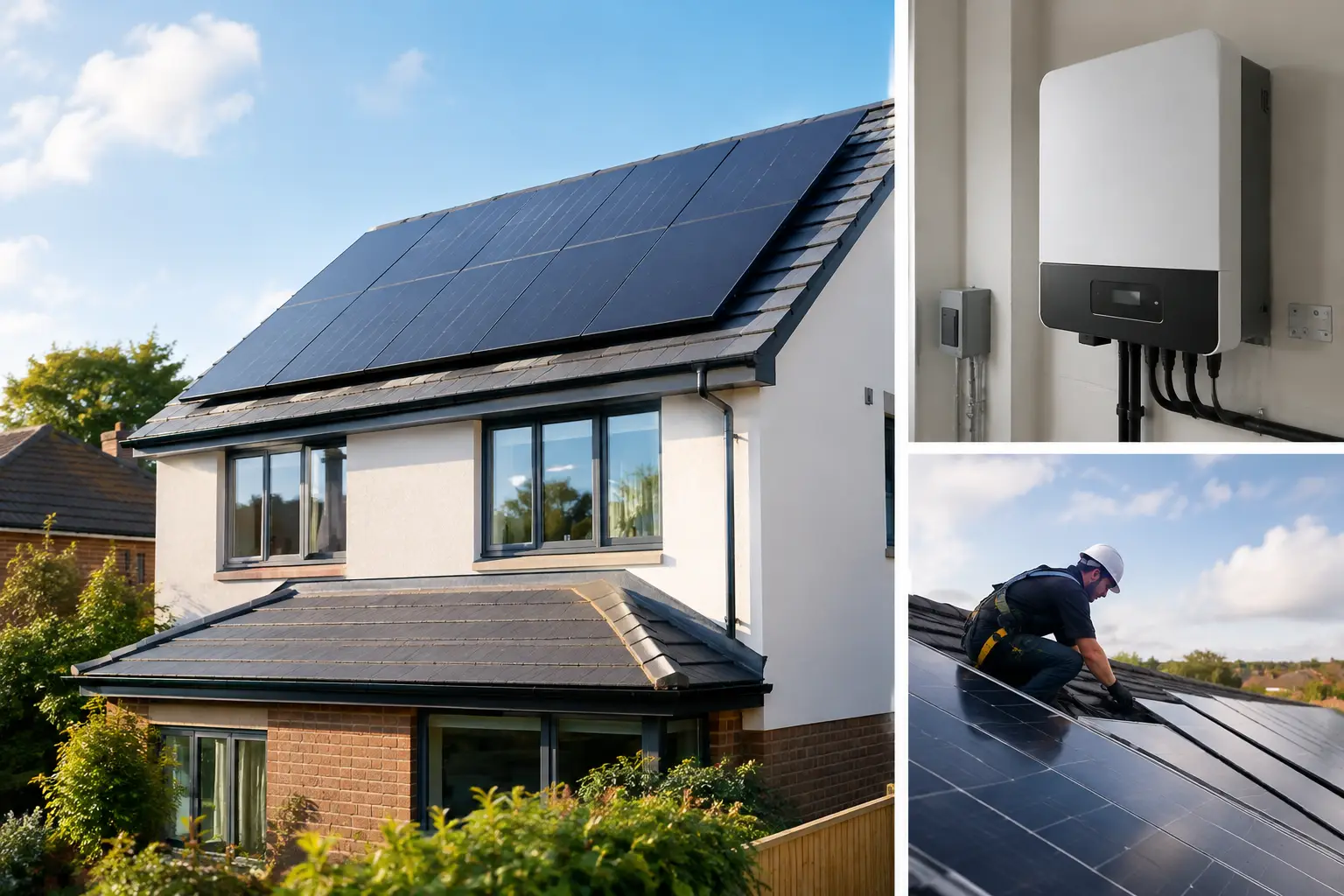
Your solar panels may get the attention, but the inverter determines how effectively their electricity works for you. It converts the direct current produced by panels into the alternating current used by your lights, appliances and business equipment. Choose well and your system can generate, store and use more of its clean energy for years. Choose poorly and you may limit performance, battery options or future expansion.
If you are asking how to choose a solar inverter, start with your property’s energy use rather than a product brand. The right model depends on the size and layout of the array, whether you want battery storage, the amount of shading on site and when you use the most electricity. A professionally designed system brings these details together before installation, rather than treating the inverter as an afterthought.
How to choose a solar inverter around your energy needs
The inverter should be matched to the panels and the way your building consumes power. A household that is empty through the day has different priorities from a retailer with daytime refrigeration loads, or a hotel with demand across the day and evening.
Start by reviewing your electricity bills, ideally across a full year. This reveals your annual consumption, peak demand and seasonal changes. For example, a home with an electric vehicle, heat pump or planned battery may need a design that accommodates higher electricity use than its current bills suggest. A commercial site may need to consider three-phase supply, operational equipment and the cost of short periods of high demand.
Panel capacity is measured in kilowatts peak (kWp), while inverter output is measured in kilowatts (kW). They are related, but they do not always need to be identical. It is common to install a solar array with a higher kWp rating than the inverter’s AC output. Panels rarely produce their nameplate rating for long in UK conditions, and modest oversizing can help the inverter generate useful power earlier and later in the day.
There is a limit, however. Too much panel capacity relative to the inverter can lead to clipping, where potential generation is lost when output exceeds the inverter’s maximum. The sensible balance depends on roof orientation, pitch, local shading and generation forecasts. It should be calculated as part of the system design, not guessed from a simple panel count.
Choose the inverter type for the roof, not just the budget
Most residential and many commercial systems use a string inverter. Panels are connected in strings and the inverter manages their combined output. This is an efficient, proven and cost-effective option for straightforward roofs with similar panel orientations and little shading.
Where a roof has several orientations, complex angles or regular partial shade from chimneys, trees and neighbouring buildings, a standard string layout may not be the best fit. One underperforming panel can affect the output of others in the same string. In these cases, panel-level optimisers or microinverters may protect more of the array’s production.
Optimisers work alongside a central inverter, managing output at individual panel level. Microinverters sit beneath each panel and convert power there. Both approaches can provide detailed panel-level monitoring and can be valuable on difficult roofs. They also add equipment and cost, so they are not automatically the right choice for an unshaded, south-facing roof.
For larger commercial properties, the decision may involve multiple string inverters, larger three-phase units or separate inverter zones for different roof areas. This can make maintenance more manageable and allow the design to reflect distinct orientations or electricity loads.
Decide early whether battery storage matters
A battery changes the role of an inverter. Without storage, a standard solar inverter converts solar electricity for immediate use and sends surplus generation to the grid. With a battery, the system needs to manage generation, household or business demand, charging and discharging in the right order.
A hybrid inverter is designed to work with both solar panels and a battery. It is often the most practical route when battery storage is part of the plan from day one. It can reduce duplicated equipment and create a more integrated system, with one platform for monitoring solar production, battery levels and grid imports.
If you want solar panels now but may add a battery later, ask whether the proposed inverter is battery-ready and which battery models it supports. “Battery-ready” can mean different things. Some systems only need a compatible battery connected later; others need additional hardware or a separate AC-coupled battery inverter. The latter can still be a good solution, particularly where a solar system already exists, but it should be clear in the quotation.
Battery storage does not automatically provide power during a power cut. Most grid-connected solar systems shut down when the grid fails to protect electrical workers. If backup power is a priority, the design needs appropriate backup or emergency-power capability, switching equipment and a defined list of essential circuits. A whole-building backup solution has different technical and budget requirements from keeping the fridge, broadband and lighting running.
Look beyond headline efficiency
Inverter efficiency matters because small percentage differences affect energy yield over the system’s life. Compare the manufacturer’s weighted or European efficiency, which better reflects real operating conditions than a single peak-efficiency figure.
Yet efficiency is only one part of performance. Check the number of maximum power point trackers, often called MPPTs. Separate MPPTs allow different strings to operate independently, which is useful when panels face different directions or are installed on separate roof sections. A property with east- and west-facing panels, for instance, should not be treated like a single south-facing roof.
Also consider the inverter’s operating voltage range and start-up voltage. These influence how early in the morning and late in the afternoon the system can begin producing useful electricity. On a commercial project, confirm that the inverter is suitable for the building’s electrical supply and proposed export arrangement.
Check monitoring, warranties and practical installation details
Good monitoring makes solar easier to manage. At a minimum, you should be able to see generation and system status through an app or web portal. For battery systems, useful monitoring also shows battery state of charge, grid imports and exports, and how much electricity the property is using.
This information is more than a nice extra. It helps you spot unusual performance, understand whether a battery is reducing evening imports and make better decisions about high-consumption appliances. For landlords and commercial operators, reporting can also support energy management and sustainability targets.
Ask how the monitoring will be commissioned, who has access to it and what support is available if a fault notification appears. A system is most useful when the owner can understand the essentials while still having a direct route to qualified technical help.
Warranty terms deserve the same care. Inverter warranties commonly differ from panel warranties and may have options for extension. Look at the length of cover, what parts and labour are included, whether remote diagnostics are available and how a replacement would be managed. An inverter is a hardworking electronic component, so aftercare and responsive maintenance support matter.
The inverter also needs a suitable, well-ventilated installation location. Garages, utility rooms and plant areas are often suitable, but the final position must account for temperature, access, cable runs, noise and the manufacturer’s clearance requirements. Outdoor-rated equipment can be appropriate, though exposure to direct sun and weather should still be considered.
Make sure the grid connection is part of the design
In the UK, grid connection requirements should be addressed before installation. Depending on the system size and export capability, your installer may need to notify the Distribution Network Operator under G98 rules or apply for approval under G99. This is particularly relevant for larger systems, battery-backed projects and commercial sites.
Export limitation may be required where the local network cannot accept the full potential export. That does not mean solar is unsuitable. It means the inverter, meter and control equipment must be configured so the property can use as much generated electricity as possible while respecting the agreed export limit.
A proper survey should also identify supply type, consumer-unit capacity, earthing arrangements and any electrical upgrades needed. For a business, planning the works around trading hours can be just as important as the technical specification.
Treat the inverter as a long-term system decision
The least expensive inverter is not always the lowest-cost choice over time. A cheaper unit that restricts battery integration, has limited monitoring or is poorly matched to roof conditions can reduce the value of the whole solar investment. Equally, paying for panel-level technology on a simple, clear roof may not produce enough extra generation to justify the cost.
The best choice is the one that fits your roof, electricity habits and future plans, supported by clear design calculations and dependable aftercare. At Shard Solar, that conversation begins with a property survey, so the inverter is selected as part of a complete system designed to help you generate and store your own power with confidence.