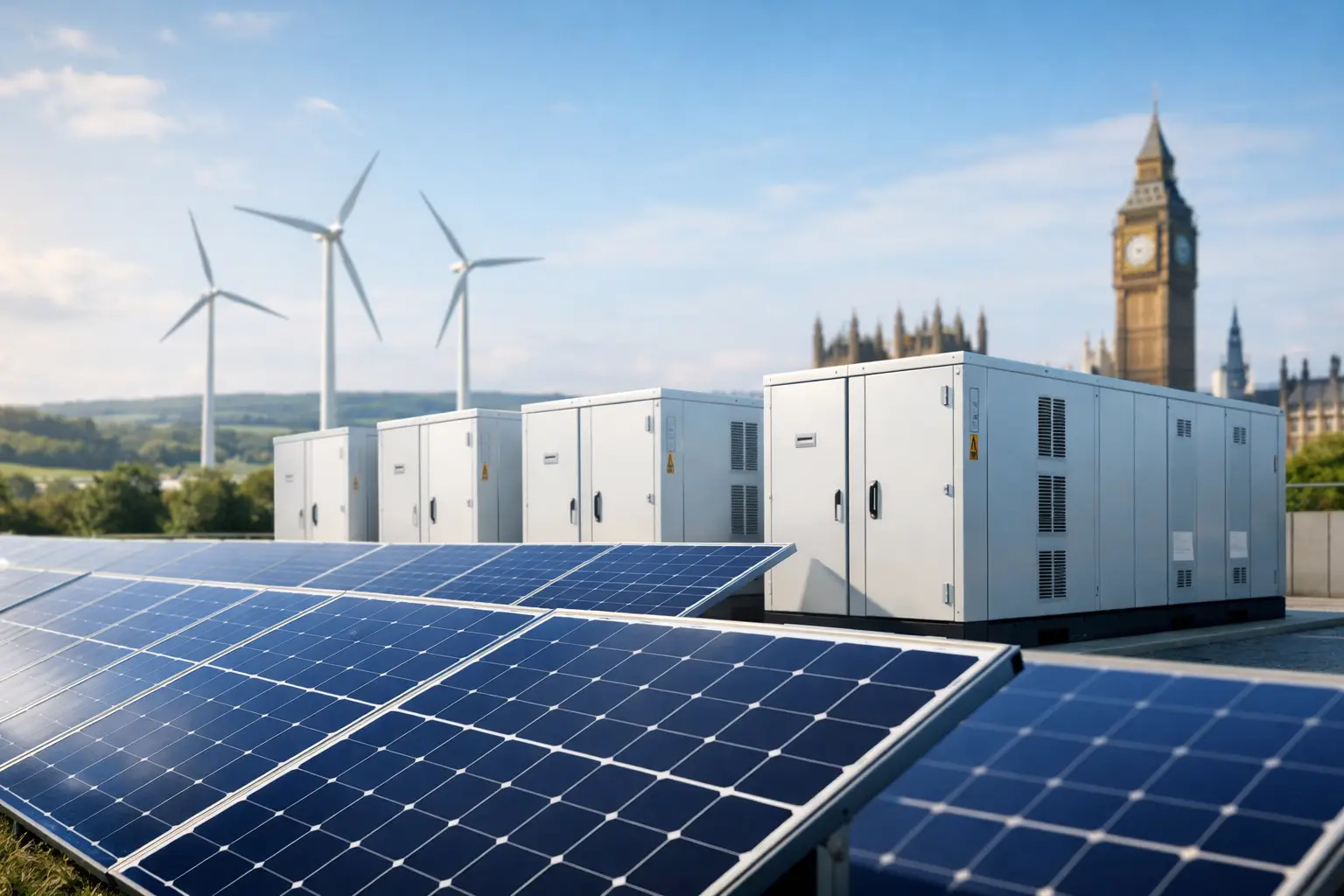
A battery is not simply an add-on to commercial solar. For a business paying higher rates in the early evening, managing a large half-hourly load or aiming to keep critical equipment running, it can change when and how on-site solar delivers value. Commercial solar battery storage cost therefore needs to be assessed against your building’s demand profile, tariff and operational priorities – not just the capacity shown on a specification sheet.
For some sites, storing surplus solar generation for later use produces a strong case from day one. For others, the better investment is a smaller battery, a larger solar array or energy-efficiency measures that reduce demand first. A properly engineered design makes that distinction clear before work begins.
What does commercial solar battery storage cost?
There is no single installed price for a commercial battery system. A straightforward battery installation in the 50-100 kWh range may cost tens of thousands of pounds, while larger systems designed for factories, hotels, residential blocks or multi-site operations can move into six-figure budgets. The difference is not only battery size. Electrical infrastructure, site conditions, controls, connection requirements and resilience features all affect the final figure.
A useful way to view the investment is through two ratings: kilowatt-hours (kWh), which measure how much energy the battery can store, and kilowatts (kW), which measure how quickly it can charge or discharge. A battery with ample kWh capacity but too little kW output may not reduce a sharp evening peak. Conversely, a high-power system with limited stored energy may only support that peak briefly.
This is why price-per-kWh figures can be misleading. They may exclude installation, switchgear, design, monitoring, fire-safety measures, electrical upgrades and the control equipment required to make the system work effectively with solar generation and site demand.
The main factors behind commercial solar battery storage cost
The battery itself is a significant part of the budget, but it is only one element of a safe, dependable commercial installation. A detailed quotation should account for the complete system and the work needed to commission it correctly.
Four areas usually have the greatest influence on price:
- Battery capacity and power rating: More stored energy and faster discharge capability increase equipment cost, but oversizing can lengthen payback.
- Solar array size and generation profile: A larger array may create more surplus electricity to store. However, generation should be matched to actual daytime consumption rather than designed around an assumed surplus.
- Electrical and connection works: Existing distribution boards, cabling, meter arrangements, transformer capacity and the Distribution Network Operator process can all affect scope.
- Operational requirements: Backup circuits, islanding capability, advanced energy-management controls, remote monitoring and fire protection add cost but may be essential for the site.
Access also matters. Installing equipment in a clear ground-floor plant area is very different from moving battery cabinets through a constrained city-centre property or locating them on a roof. Surveying the property properly at the outset helps identify these practical considerations before they become costly changes on site.
Backup power costs more than stored solar
Many businesses assume that a battery automatically provides power during a grid outage. In most cases, it does not. Standard systems are designed to operate alongside the grid and shut down when the network fails, unless they include dedicated backup or islanding equipment.
If continuity is a priority, the design must identify which loads need support. That may be refrigeration, emergency lighting, IT equipment, security systems or a limited production line rather than the entire building. Selecting critical circuits can control the cost of resilience while protecting the operations that matter most.
Where the financial return comes from
The strongest business case is usually built from several savings rather than one. First, the battery can increase solar self-consumption by holding surplus daytime generation for use later in the day. This reduces the amount of electricity purchased from the grid when the building is still operating but solar output has fallen.
Second, a battery can reduce costly demand peaks. Sites with concentrated loads – such as commercial kitchens, cooling equipment, machinery, EV charging or multiple shared services – may benefit from discharging the battery at key times. The value depends on the tariff and the timing of those peaks, which is why half-hourly data is so valuable.
Third, intelligent controls may allow charging when grid electricity is cheaper and discharging when it is more expensive. This should be approached carefully: tariff arbitrage alone may not justify a battery, and projected savings should allow for efficiency losses, cycling limits and changing energy prices. It is more compelling when combined with solar generation and peak management.
Export is another consideration. If a business receives relatively little for surplus exported solar electricity, using that electricity on site later can be more valuable than sending it to the grid. The precise comparison depends on the import tariff, export arrangement and expected solar output throughout the year.
Start with your load profile, not a battery size
A credible proposal starts with evidence. Electricity bills provide useful context, but interval data shows when the site actually consumes power. It reveals whether demand rises after solar production drops, whether large loads start simultaneously and whether weekend consumption differs from weekdays.
For example, a retailer with strong daytime demand may gain more from maximising direct solar use than from installing a very large battery. A hotel with evening activity, laundry and kitchen loads may have a clearer case for storage. A food manufacturer may require a design that considers refrigeration loads, operating schedules and the consequences of interruption, alongside potential solar savings.
The right system may also change as the business develops. If EV chargers, heat pumps, extra refrigeration or new production equipment are planned, they should be considered during design. Allowing for future demand can avoid costly alterations, while still keeping the first installation proportionate to current needs.
Ask for assumptions, not just payback
Simple payback is useful, but it should never be the only number a commercial decision-maker sees. A good financial model states the assumptions behind its forecast: energy import rates, export value, annual solar generation, battery cycles, degradation, maintenance and the expected life of the equipment.
It should also explain what is included in the price. Does the quotation cover design, permissions, network applications, installation, testing, commissioning, monitoring and aftercare? Are warranties clearly separated for panels, inverters, battery equipment and workmanship? Transparent scope is often more valuable than a low headline figure that leaves essential electrical work outside the quote.
Businesses should also take advice on current tax treatment, capital allowances and any available local or sector-specific support. These can affect the overall investment case, but eligibility and rules can change, so they should not be treated as guaranteed savings until confirmed for the individual business.
Designing a battery around the building
The lowest commercial solar battery storage cost is not always the best value. A system that is too small may miss the peaks it was intended to manage; one that is too large may leave capacity unused for much of the year. The goal is to make every part of the system earn its place.
That requires a site survey, a review of consumption and a clear conversation about priorities. Is the business seeking lower bills, improved resilience, greater use of clean on-site generation, support for EV charging or all of these? The answer shapes the equipment, the controls and the installation plan.
At Shard Solar, the process begins with understanding the property and its energy use, then turning that information into a detailed, practical quotation. Design, engineering, installation and ongoing monitoring should work as one managed service, with minimal disruption to the people using the building.
The most useful next step is to gather recent electricity bills and, where available, half-hourly consumption data. With a clear picture of your load, a battery can be sized to support the way your business actually operates – helping you retain more of your solar power and make confident decisions about long-term energy costs.