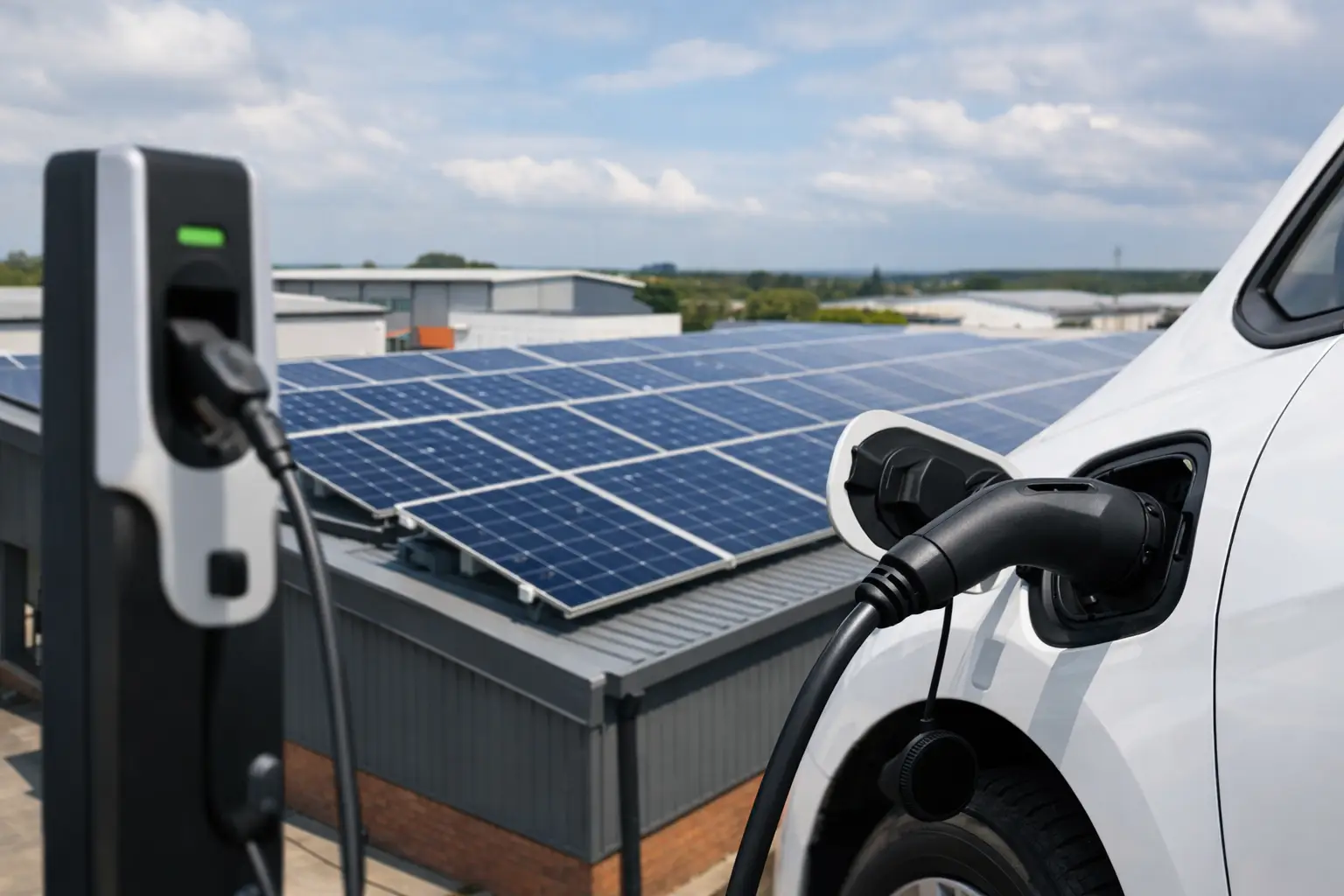
A home EV can add a significant new demand to your electricity bill, particularly if you charge after work. Solar panels with EV charger give you a practical way to generate more of the power your car needs on site, rather than relying entirely on grid electricity. The best results come from designing the solar, charger and, where appropriate, battery storage as one connected system.
For homeowners, this can mean lower motoring costs and more control over when electricity is bought. For landlords, developers and commercial sites, it can support charging provision without placing unnecessary strain on a building’s electrical supply. It is not a case of fitting panels and expecting every mile to be free, however. Your driving pattern, roof space, daytime energy use and charging habits all affect the outcome.
How solar panels with EV charger work
Solar panels generate direct-current electricity whenever daylight reaches them. An inverter converts that power for use in your property, where it can supply household appliances, charge a battery or feed a compatible EV charger. Any electricity you do not use immediately may be exported to the grid, depending on your export arrangement.
In practice, the car does not draw power directly from the panels. Your home’s electrical system balances solar generation, property demand, battery charging and EV charging in real time. A smart charger can monitor available surplus generation and adjust the car’s charging rate accordingly.
This matters because solar output changes through the day. A car plugged in at home on a bright weekday can make good use of surplus solar, especially once the household’s base demand has been met. A car that arrives at 6 pm in winter will usually need a different approach, such as charging from a home battery, using a lower-cost off-peak tariff, or a combination of both.
The savings depend on when you charge
The financial case is strongest when you can use electricity as it is generated. Every unit of solar power used to charge your vehicle is a unit you do not need to buy at the full import rate. That is why daytime charging is valuable for people who work from home, have flexible schedules, or can leave their car at home during the day.
A smart charger helps turn that opportunity into a routine. In surplus mode, it can prioritise excess solar after the property’s immediate electricity needs are covered. In scheduled mode, it can charge during an off-peak period when grid electricity is cheaper. Many households use both modes: solar-led charging on suitable days, then scheduled charging when they need certainty that the car will be ready.
There is a trade-off. Restricting charging to solar surplus alone may be too slow for a high-mileage driver or a household with a small array. Most domestic solar systems produce much less electricity in December than in June, precisely when more lighting and heating-related electricity may also be needed. A well-designed setup gives you control, rather than forcing you to choose between clean energy and a reliably charged car.
Choosing the right solar system size
Your EV should be included in the system design from the start. A typical electric car may use roughly 2,000 to 3,500 kWh of electricity a year, depending on mileage, vehicle efficiency and driving conditions. That is a meaningful addition to a home’s annual consumption.
The right system size is not simply the one that matches your car’s annual usage. A larger array may generate more energy over a year, but its value depends on how much can be used, stored or exported at worthwhile rates. Roof orientation, shading, available area, planning considerations and the property’s existing demand all need to be assessed.
For a commercial property, the timing can be especially favourable. Offices, retailers, hotels and manufacturing sites often have substantial daytime electricity use, which can support on-site solar consumption while staff or fleet vehicles charge. Conversely, a workplace with many vehicles all charging at once may require load management and electrical upgrades. The charger provision must be engineered around the site’s capacity, not added as an afterthought.
A property survey should examine your consumption data, main electrical supply, roof condition and likely future loads. It is sensible to discuss planned additions too, such as a heat pump, electric cooking, air conditioning or further EVs. Designing for the direction your energy use is heading can avoid costly changes later.
Do you need battery storage?
A battery is not essential for solar EV charging, but it can increase flexibility. It stores surplus generation for use later in the day, helping you run household appliances or add some power to the car after sunset. It can also be charged from the grid at off-peak rates where this suits your tariff and charging plan.
The main limitation is capacity. Home batteries are designed to support a property’s evening use and improve solar self-consumption; they are usually far smaller than an EV battery. Charging an electric car solely from a home battery can deplete it quickly, leaving less stored power for the home. For that reason, many households treat the battery as part of a wider energy strategy rather than a dedicated car-charging tank.
Battery storage can be particularly worthwhile where evening electricity demand is high, export payments are modest, or resilience and greater self-reliance are priorities. If your car is regularly at home during sunny hours, extra solar capacity and smart charging may deliver more direct EV benefit than a larger battery. The right balance depends on your household’s actual half-hourly usage, not a generic package.
Why the charger specification matters
A dedicated EV charger is safer, faster and easier to manage than relying on a standard socket. The appropriate power rating depends on your electrical supply and the vehicle, while the physical location needs to work for everyday parking without trailing cables across access routes.
Look for a charger that supports scheduled charging, dynamic load balancing and solar integration. Dynamic load balancing is particularly useful because it monitors the building’s demand and can reduce the charging rate before the main supply is overloaded. This can protect against nuisance tripping and may reduce the need for expensive supply upgrades.
For shared parking, rental homes and business premises, access control and usage reporting may also matter. You may need to distinguish between electricity supplied to tenants, staff, visitors or fleet vehicles. A professional electrical assessment is essential where several charge points are planned.
A sensible order for planning the project
Start with your energy needs, not the make of charger. Collect a year’s electricity bills where possible, estimate your expected annual mileage, and consider when the car is normally parked at the property. That gives a clearer picture of solar potential and charging demand.
Next, assess the building. A survey can identify usable roof areas, shading, cable routes, consumer unit capacity, meter arrangements and the best charger location. At this stage, a good designer will also explain what can be achieved in summer versus winter, rather than presenting annual generation figures as a promise of daily output.
Then decide how the system should operate. You might prioritise solar surplus, protect a minimum battery level for evening use, schedule off-peak top-ups, or set a departure-time target for the vehicle. These settings can be adjusted as your routine changes, but the equipment must be selected and installed to support them safely.
At Shard Solar, an integrated survey and quotation process can bring the solar, battery and electrical work into one plan. That avoids the common problem of separately specified systems that do not communicate properly or leave insufficient capacity for the charger.
Make charging part of a wider energy plan
An EV charger can make solar feel immediately useful because it turns rooftop generation into miles travelled. Yet its greatest value is not chasing the idea of charging exclusively from sunshine. It is having an energy system that responds intelligently to your property, your tariff and the way you actually drive.
With the right design, solar generation can reduce daytime electricity purchases, battery storage can extend useful energy into the evening, and smart charging can ensure your vehicle is ready when you need it. That is a practical route to lower running costs, cleaner transport and greater confidence in your own energy supply.