A solar panel system can produce plenty of electricity at midday, just when many homes are quiet and some businesses have lower demand. Without a battery, unused generation is usually exported to the grid. With one, that surplus can be kept on site for later. So, how does solar battery storage work? It captures electricity your panels do not need immediately, then releases it when your property needs power – often in the evening, overnight, or during higher-cost periods.
For homeowners, this can mean using more of the clean electricity generated from their own roof. For commercial sites, it can support a more predictable energy strategy, particularly where daytime generation and operating demand do not always match. The right result depends on your consumption pattern, tariff, system design and whether resilience during a power cut is a priority.
How does solar battery storage work day to day?
Solar panels generate direct current (DC) electricity when daylight reaches their cells. Most buildings use alternating current (AC), so an inverter converts that solar power into electricity that can run lighting, appliances, equipment and other loads.
The system first supplies the property with available solar generation. If the panels are producing more than the building is using, the surplus can charge the battery. Once the battery is full, any remaining electricity may be exported to the grid, subject to the agreed connection arrangement.
Later, when solar output falls below demand, the battery discharges stored energy back through the inverter to help power the property. This happens automatically. A properly commissioned system monitors generation, battery level and household or business demand continually, deciding where electricity should go according to its programmed settings.
For example, a home may generate strongly between late morning and mid-afternoon. The battery stores the excess, then helps cover cooking, lighting and entertainment use after sunset. A retail site may use stored solar power into the early evening, when lighting, refrigeration or point-of-sale equipment remain active but panel output has dropped.
The key parts of a battery storage system
A battery is not simply a large power bank attached to solar panels. It works as part of an engineered system, with each component affecting performance, safety and the value you receive from it.
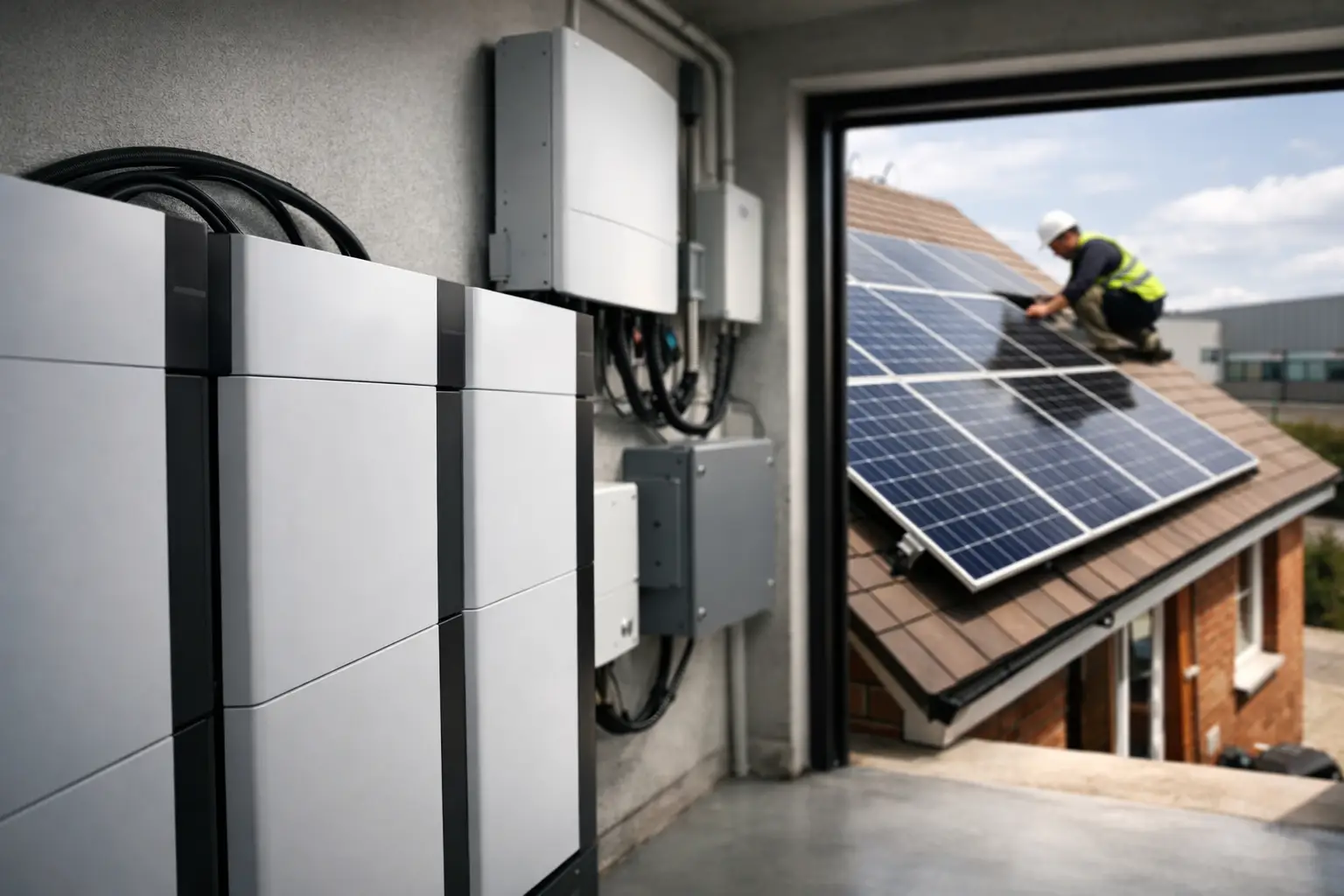
The solar array generates electricity, while the inverter manages conversion between DC and AC electricity. The battery itself stores energy, usually using lithium-ion technology. A battery management system supervises charging, discharging, temperature and cell health to help protect the unit and extend its working life.
Smart monitoring is equally useful. It lets owners see production, consumption, battery charge and grid imports in one place. That visibility can reveal when the property is using the most electricity and whether a change in behaviour, such as running energy-intensive equipment during sunny hours, could increase savings.
Some systems use a hybrid inverter, designed to manage both solar panels and battery storage together. Others can be added to an existing solar system using an AC-coupled battery. Neither approach is automatically better. The most suitable option depends on the existing equipment, available space, electrical layout, future expansion plans and budget.
Capacity and power are not the same thing
When comparing batteries, two figures matter particularly: capacity and power output.
Capacity, measured in kilowatt-hours (kWh), is the amount of electricity a battery can store. A 10 kWh battery has more stored energy available than a 5 kWh battery, although the usable capacity may be slightly lower than the headline figure to protect battery life.
Power, measured in kilowatts (kW), describes how much electricity the battery can supply at one time. A battery with modest output may cover background electricity use comfortably but may not run several high-demand appliances simultaneously without support from the grid.
This distinction matters for both homes and businesses. A larger battery does not necessarily deliver the high output needed for an electric shower, commercial kitchen equipment or multiple heavy loads operating at once. Conversely, a high-power battery with limited capacity may provide a strong short burst but run down quickly.
A good design starts with real consumption data rather than a standard battery size. Reviewing half-hourly usage, daily operating hours and seasonal demand gives a much clearer picture of what the system should achieve.
When will a solar battery save the most?
Battery storage is particularly valuable where a property produces surplus solar electricity during the day but imports significant electricity later. Instead of buying all evening power from the grid, the property can use its stored generation first.
Savings can also improve with time-of-use tariffs. Some tariffs charge different rates at different times of day. In certain circumstances, a battery can be programmed to charge from the grid when electricity is cheaper and discharge when rates are higher. Whether this is worthwhile depends on tariff terms, battery efficiency, standing charges and how much solar energy is available.
There are trade-offs. Electricity is lost during charging and discharging, known as round-trip efficiency losses. Batteries also have a finite cycle life, although quality systems are designed for many years of regular use. A battery that is too large for the amount of surplus solar a property produces may spend much of the year underused. One that is too small may fill early and leave more solar energy to export.
For this reason, the best battery is rarely the biggest one. It is the one sized around the building’s generation profile, demand pattern and financial goals.
Can battery storage keep the power on during a cut?
Not every solar battery provides backup power during a grid outage. Many standard systems are designed to switch off when the grid fails, which is a safety requirement that protects engineers working on local electricity networks.
A system with backup capability needs the appropriate equipment and design, often including an automatic changeover arrangement and a dedicated backup circuit. It can then supply selected essential loads, such as lighting, a fridge, broadband, security systems or certain sockets, depending on the system’s output and battery level.
Whole-property backup is possible in some cases, but it requires careful assessment. High-demand equipment can drain a battery quickly, and three-phase commercial supplies require particular attention. Backup should therefore be specified from the outset rather than assumed to be included with every battery installation.
What affects battery performance in the UK?
Solar generation changes through the seasons. A battery may charge fully on many bright summer days, while winter production is naturally lower and stored solar energy may cover less of the evening demand. That does not make storage ineffective in winter, but expectations should be based on annual performance rather than July figures alone.
Temperature, installation location and ventilation also matter. Batteries need a suitable, accessible position that meets manufacturer requirements and allows safe electrical work. For homes, this might be a utility area, garage or external location. For commercial buildings, the design must account for access, fire safety, load requirements and the continuity of business operations.
The quality of installation matters as much as the equipment choice. Accurate system design, compliant electrical work, careful commissioning and clear handover information all help ensure the battery operates as intended. Ongoing monitoring can then highlight unusual performance before it becomes a larger issue.
Making storage part of a wider energy plan
A battery works best when it is considered alongside the whole property. Energy-efficiency improvements reduce the amount of electricity that must be bought or stored. Electric vehicle charging can be scheduled around solar generation. Heat pumps, air conditioning and other major loads should be considered when sizing both the solar array and battery.
For landlords, developers and commercial decision-makers, this whole-building view is especially useful. Occupancy patterns, tenant demand, roof capacity, grid connection limits and planned equipment upgrades can all affect the right design. A detailed property survey makes it possible to move beyond estimates and build a system around how the site actually operates.
Solar battery storage is ultimately about timing: generating clean electricity when the sun is available, then using it when it has the greatest value to your property. With a system designed around real demand and supported by professional commissioning and aftercare, that timing can bring greater control over bills, carbon emissions and the way your building uses energy.