
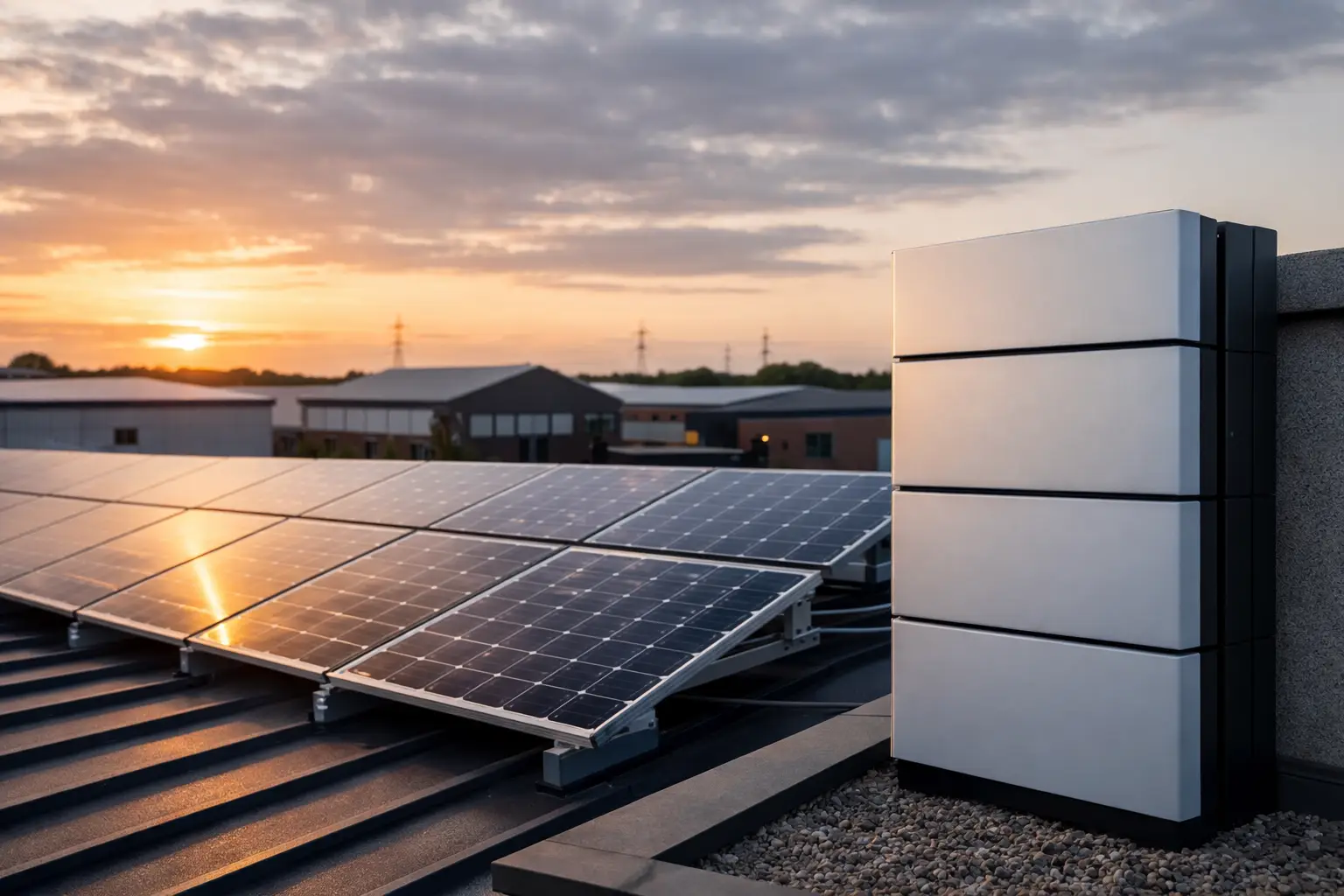
The best batteries for evening use are not necessarily the largest units available. They are the batteries sized around what your property actually consumes between late afternoon and bedtime, when solar generation falls but cooking, lighting, heating controls, entertainment and EV charging can push demand up. The right system stores surplus electricity produced during the day, then releases it when buying from the grid is most expensive or least desirable.
For a typical UK household, a solar battery can make daytime generation far more useful. For landlords, developers and commercial sites, the same principle applies on a larger scale: storage can shift low-cost or self-generated electricity into the hours when demand and tariffs rise. The best choice comes down to usable capacity, power output, safety, warranty and how intelligently the battery works with the wider solar system.
What makes a battery good for evening use?
Evening use is a specific job. A battery needs enough stored energy to cover the regular hours after solar production drops, and enough power to run several appliances at once without relying on the grid. These are related measurements, but they are not the same.
Capacity, measured in kilowatt-hours (kWh), tells you how much energy the battery can store. Power, measured in kilowatts (kW), tells you how quickly it can deliver that energy. A 10 kWh battery with a 3 kW output may cover a long, modest evening load well, but it can struggle if an induction hob, kettle, oven and other high-demand appliances run together. A battery with stronger output can handle higher peaks, though it may not last as long if its storage capacity is modest.
For most homes, the best batteries for evening use balance both figures rather than focusing on one headline number. They should also have a high usable capacity. Battery manufacturers often state a total capacity and a usable capacity, with part of the battery protected to support its lifespan. Compare the usable figure when assessing how much evening electricity you can realistically store.
Start with your evening energy pattern
A system should be designed around consumption, not just roof size or a neighbour’s installation. Look at smart-meter data or electricity bills to understand what happens after 4 pm. Many homes use relatively little power through the afternoon, then see a sharp rise between 5 pm and 10 pm. The pattern changes again in winter, when lights are on earlier and solar production is lower.
A household that mainly wants to cover lighting, refrigeration, broadband, television and normal cooking may be well served by a battery with around 5 to 10 kWh of usable storage. A larger family home with electric cooking, a heat pump, an EV or frequent evening appliance use may need 10 to 15 kWh or a modular system that can expand later. There is no universal ideal size, because a large battery that rarely fills is not automatically good value.
Commercial properties need a more detailed load assessment. A retailer may benefit from reducing lighting, refrigeration and air-conditioning demand after trading hours. A hotel or food manufacturer may have substantial, continuous loads that justify multiple batteries and a carefully engineered control strategy. In these cases, interval data is essential for identifying whether batteries should prioritise self-consumption, peak shaving, tariff optimisation or resilience.
Think about winter, not only sunny days
Summer output can make almost any battery look effective. The more useful test is whether the system supports your priorities in spring, autumn and winter. Solar panels generate less during short, overcast days, so a battery may increasingly charge from the grid on an off-peak tariff rather than from surplus solar.
That is not a failure of the system. It can still reduce costs if it charges when electricity is cheaper and discharges during expensive evening periods. The financial case depends on the difference between those tariff rates, the battery’s round-trip efficiency and your willingness to adjust usage habits. A professional design should show realistic annual performance rather than relying only on summer examples.
Lithium iron phosphate is often the sensible choice
Most modern residential solar batteries use lithium-ion chemistry, but the type matters. Lithium iron phosphate, often referred to as LFP, is widely favoured for fixed home and business storage because it offers strong thermal stability and a long cycle life. It is well suited to regular daily charging and discharging, which is exactly what an evening-use battery is expected to do.
Other lithium-ion chemistries can offer a compact footprint and high energy density. However, chemistry alone should not decide the purchase. Check the manufacturer’s quoted usable capacity, expected cycle life, efficiency, operating temperature range and warranty conditions. Also consider where the unit will be installed. A garage, utility room or external wall may each involve different practical considerations, and the equipment must be installed in a suitable, well-considered location.
Choose power output for real household peaks
It is easy to size a battery for average consumption and overlook the short periods that matter most. Evening demand often arrives in bursts. Someone starts dinner while the dishwasher runs, another person boils a kettle, and an EV may begin charging as soon as it is plugged in.
A battery’s continuous output is the key figure for normal operation, while peak output shows what it may deliver briefly. For many households, a system capable of supplying roughly 3.6 kW to 5 kW continuously offers a useful level of support. Homes with higher electrical loads may need more. Yet a battery should not be expected to make every large appliance free to run. Electric showers, immersion heaters and rapid EV charging can draw energy quickly enough to empty storage or require grid support.
This is where system controls earn their place. Smart monitoring can prioritise battery energy for the loads that matter, schedule EV charging for cheaper hours and avoid unnecessary grid imports. The best result is usually a coordinated solar, battery and tariff strategy, not a battery working in isolation.
AC-coupled or DC-coupled storage?
The best setup depends partly on whether you are adding a battery to existing solar panels or installing everything at the same time.
DC-coupled batteries connect on the solar side of a hybrid inverter. They can be highly efficient because electricity from the panels does not need to undergo as many conversion stages before being stored. This option is often attractive for a new solar-and-storage installation, provided the selected inverter and battery are compatible.
AC-coupled batteries connect to the property’s AC electrical system. They are often practical for retrofitting storage to an existing solar array, particularly where replacing a working solar inverter would add unnecessary cost. There can be slightly more conversion loss, but the flexibility can make it the right answer. A site survey should consider existing equipment, electrical capacity, cable routes and future expansion before choosing either approach.
Do you need backup power as well?
Evening self-consumption and power-cut backup are different requirements. Many batteries continue to operate normally during grid-connected evenings but do not automatically power the property when the network fails. To provide backup, the system needs compatible hardware, appropriate changeover arrangements and a design that defines which circuits are supported.
Some customers want a protected supply for essentials such as lighting, refrigeration, internet and selected sockets. Others require a more comprehensive backup solution. The latter may need higher battery output, more stored energy and careful management of major loads. If backup matters, raise it at the quotation stage rather than assuming it is included with any solar battery.
Compare warranties, monitoring and expansion options
A long warranty is reassuring, but read what it promises. Battery warranties commonly specify a number of years, a minimum retained capacity and a throughput limit. A 10-year warranty can be valuable, but only if its terms match the expected daily use of the system. Ask how labour, call-outs and replacement equipment are handled too.
Good monitoring is equally practical. A clear app or portal should show solar generation, household consumption, battery state of charge and grid imports or exports. This helps you see whether the battery is covering the evening period as intended and spot opportunities to shift demand.
Finally, consider the next five years. If you expect to buy an EV, install a heat pump, convert a loft or increase occupancy, a modular battery system can be a sensible route. Expansion should be planned, though, rather than assumed. Not every model can accept additional battery modules later, and compatibility rules can vary by generation.
A better way to choose your battery
The best battery is the one that fits your roof’s solar production, your genuine evening consumption and your electricity tariff. It should be safely installed, correctly commissioned and supported with straightforward performance visibility. Chasing the highest kWh figure without considering output, seasonal generation and future loads can lead to storage that costs more than it returns.
At Shard Solar, this starts with understanding the property and its energy goals before recommending a system. A considered survey can reveal whether a compact battery, expandable storage, tariff-led charging or a larger engineered solution will give you the greatest control after sunset. That is where evening savings become a dependable part of how your property uses energy, rather than a promise based on the sunniest day of the year.