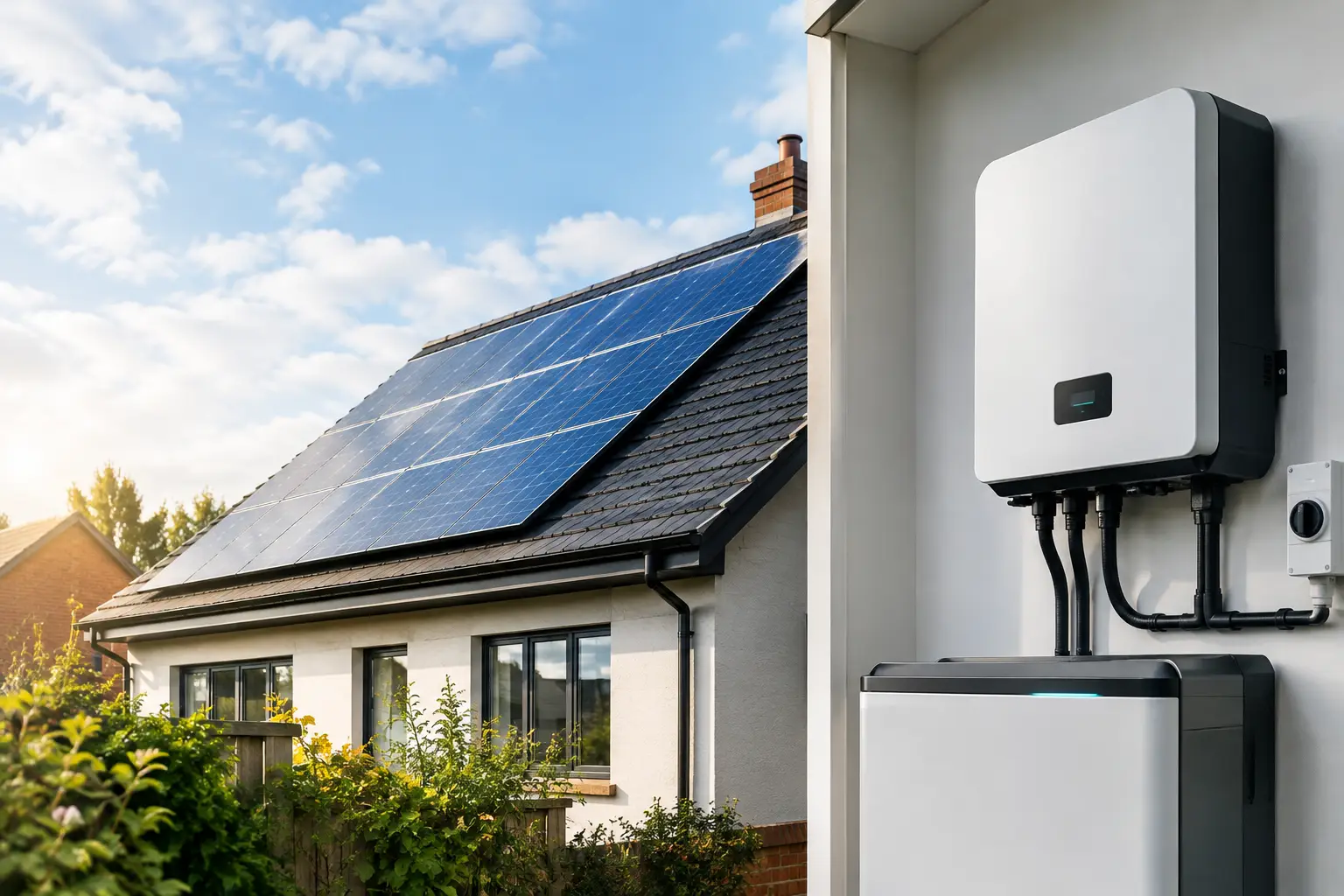
A solar array may be the visible part of your system, but the inverter decides how effectively that daytime generation becomes useful electricity in your home. The best solar inverters for homes are not simply the highest-rated units on a specification sheet. They are the models that suit your roof, electricity use, future battery plans and the way you want to manage energy after sunset.
For a typical UK household, an inverter should deliver reliable conversion, clear monitoring and sensible options for expansion. Choosing well at the design stage can also prevent an avoidable replacement when you later add a battery, EV charger or more panels.
What a home solar inverter actually does
Solar panels produce direct current (DC) electricity. Your appliances and the national grid use alternating current (AC), so the inverter converts one into the other while continuously managing voltage, frequency and safety requirements.
It also does more than conversion. A good inverter tracks the performance of the panels, responds to changes in sunlight, limits export where required, and communicates with monitoring software. In a battery-ready system, it can direct surplus generation into storage rather than sending it straight to the grid.
That makes the inverter the working centre of a solar installation. Panels may remain productive for 25 years or more, while an inverter commonly has a shorter warranty period and may be replaced once during a system’s lifetime. Quality, service support and the right design therefore matter as much as the upfront price.
The main types of solar inverter for a home
String inverters
A string inverter connects a group of panels in series, usually on the same roof aspect. It is the most common choice for homes with a straightforward, largely unshaded roof and a consistent panel layout.
String systems are efficient, proven and generally cost-effective. Most modern units have two or more maximum power point trackers, known as MPPTs. These allow separate panel strings – for example, east- and west-facing roof sections – to operate independently.
The trade-off is that panels within the same string can be affected by the weakest performer. A chimney shadow, nearby tree or heavily soiled panel may reduce output across that group unless the design uses optimisers.
Hybrid inverters
A hybrid inverter combines solar conversion and battery control in one unit. It is often the strongest option for households that want to store surplus power now, or that know battery storage is likely within the next few years.
By keeping the solar and battery equipment within one coordinated system, a hybrid design can be neat, efficient and easier to monitor. It can prioritise solar generation for household loads, charge the battery with excess production and reserve stored energy for the evening. Some configurations can also support backup circuits during a power cut, though this needs dedicated equipment and should never be assumed as standard.
A hybrid inverter is not automatically the best answer for every property. If your existing solar system already has a sound string inverter, an AC-coupled battery can sometimes be a practical way to add storage without replacing the original equipment.
Microinverters and optimised systems
Microinverters are fitted beneath individual panels, converting DC to AC at roof level. Because each panel works independently, they are particularly useful where shading is variable, roof shapes are complex or panels face several directions.
Panel-level monitoring is another attraction. It can make it easier to identify underperforming modules and gives homeowners a detailed view of generation. The compromise is a higher initial cost and more electrical equipment on the roof, where access for future work is less convenient.
Power optimisers offer a middle ground. They are fitted to individual panels but work with a central inverter, helping reduce the impact of uneven shading while retaining a more conventional inverter arrangement.
Which brands are among the best solar inverters for homes?
There is no single winner for every UK property, but several established manufacturers regularly appear in professionally designed domestic systems. The right choice should be based on approved compatibility, warranty terms, local technical support and the complete system design – not on brand recognition alone.
SolarEdge is often suited to roofs with shading, different orientations or layouts where panel-level optimisation adds value. Its optimiser-led approach gives detailed visibility and can improve design flexibility, although it is usually more expensive than a standard string system.
Enphase is a well-known microinverter choice for complicated roofs and homeowners who value individual-panel performance data. It can be an excellent technical fit, but the additional equipment can make it less economical for a simple, unshaded south-facing roof.
GivEnergy, Fox ESS and Sunsynk are frequently considered for battery-led home energy systems in the UK. Their hybrid inverter ranges can be attractive for households aiming to increase self-consumption, use time-of-use tariffs or add an EV charger. Features and battery compatibility differ by model, so sizing and controls need careful review.
Huawei offers string and hybrid inverter options that can suit clean, modern installations, including systems designed around future storage. As with any ecosystem, confirm which batteries, optimisers and backup components are approved for the exact unit being specified.
The best manufacturer is the one that solves the property’s practical needs without creating unnecessary complexity. A capable installer should explain why a particular inverter has been selected rather than offering a one-size-fits-all package.
Size the inverter around your roof and electricity use
Inverter sizing is not always a simple match to the combined panel wattage. A 4 kWp solar array, for example, may use an inverter rated below 4 kW where the roof orientation means the panels are unlikely to reach their full output at the same time. This can reduce equipment cost while having little effect on annual generation.
However, undersizing too aggressively can clip production during bright conditions. Oversizing can increase cost without a meaningful gain. The sensible ratio depends on the panel orientation, local shading, panel capacity, export limits and whether a battery will charge from solar.
A home with an east-west roof often produces a broader generation curve than one facing due south. That can align well with morning and evening household demand, but it should also affect how strings and MPPTs are arranged. This is why a property survey is more valuable than selecting an inverter solely from an online comparison.
Features worth asking about before installation
Monitoring should be easy to use and show generation, household consumption, grid import, export and battery activity where applicable. Clear data helps you adjust habits, such as running the washing machine during solar hours, and allows faults to be spotted sooner.
Battery compatibility is equally important. Ask whether storage can be added later, the maximum battery capacity supported, and whether the system can work with a third-party battery or only one brand. Closed systems are not necessarily a problem, but the restriction should be clear before you commit.
For UK installations, the inverter must meet the relevant grid connection requirements. Smaller domestic systems usually follow G98 notification rules, while larger installations or systems requiring export capacity may need G99 approval from the local Distribution Network Operator. A professional installer will manage this process and design the system around any agreed export limit.
Also check the product warranty, workmanship warranty, expected response process if there is a fault, and whether monitoring remains available if the manufacturer’s app changes. A longer warranty has value only if there is a realistic route to support and replacement.
Do not confuse solar with backup power
Many homeowners assume panels will keep the lights on during a grid outage. Standard grid-connected inverters are required to shut down when the grid fails, protecting engineers working on local lines. Solar generation alone does not provide backup power.
If resilience is a priority, discuss a battery, backup gateway or changeover equipment, and the circuits you want to protect. Supporting the broadband router, lighting, fridge and selected sockets is very different from running an electric shower, induction hob or whole-house heating. The design needs to reflect realistic loads and the capacity of the battery.
A better way to choose
The most useful question is not, “Which inverter is best?” It is, “Which inverter will make the most of this home’s energy?” Start with the roof survey, then consider shading, orientations, daytime consumption, future battery use and any plans for an EV or heat pump.
At Shard Solar, that conversation begins with the property rather than a fixed product package. A properly engineered system should give you a clear view of expected generation, storage options, export arrangements and aftercare before installation begins.
Choose an inverter that leaves room for the way your household may use electricity in five years, not just the way it uses it this afternoon. That is how solar becomes a dependable source of cleaner, lower-cost power rather than simply another item on the roof.