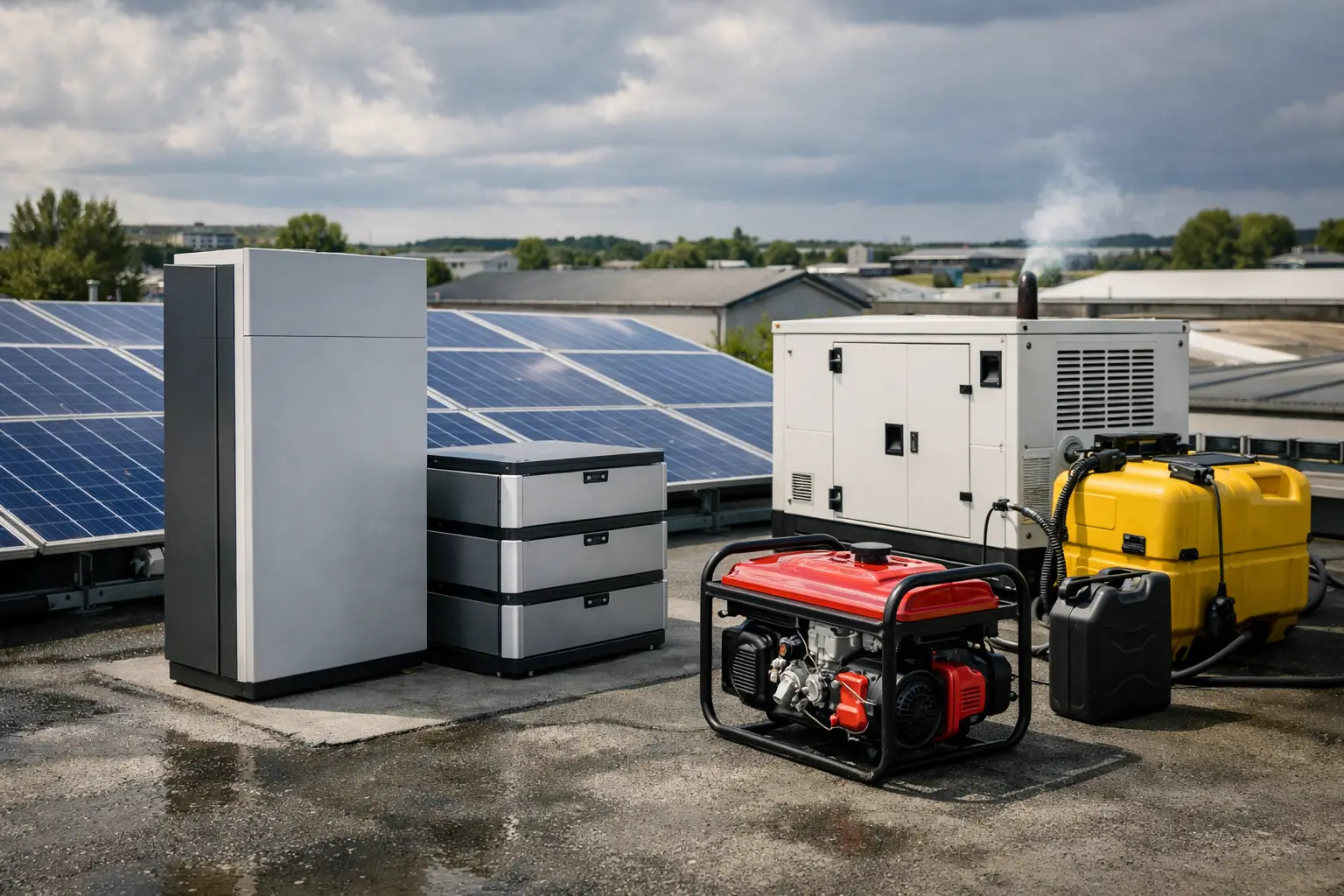
A power cut at 7pm presents a very different problem from high electricity bills every month. That distinction is the starting point when comparing solar batteries versus generators. Both can keep selected equipment running when the grid fails, but they do it in fundamentally different ways – and one may offer far more value for your property over the rest of the year.
For many homes and businesses, a generator is an emergency-only asset: useful when it starts, costly and inconvenient when it does not. A battery storage system is usually designed to work every day, capturing surplus solar electricity or lower-cost grid power for later use. The right choice depends on the type of resilience you need, your electricity use, the site itself and whether reducing ongoing energy costs matters as much as backup power.
Solar batteries versus generators: the key difference
A solar battery stores electrical energy. During daylight hours, solar panels may generate more power than a building is using. Rather than exporting all of that surplus to the grid, a battery can retain some of it for the evening, when demand often rises and solar generation falls. Depending on the system design and tariff, it may also charge from the grid during lower-priced periods.
A generator creates electricity by burning fuel, most commonly petrol, diesel, natural gas or LPG. It runs when needed, provided it has fuel, is maintained and can operate safely. Generators have long been used for sites where loss of power would cause serious disruption, from food production facilities to remote properties and critical commercial operations.
This means the comparison is not simply about which option provides backup. It is about whether you want a system that earns its place daily by increasing self-consumption of solar power and reducing grid reliance, or a standby source intended mainly for exceptional events.
How each option performs in a power cut
A battery can provide quiet, near-instant backup when it is installed with the correct backup equipment. This point matters: not every solar battery automatically keeps a property powered during an outage. Standard grid-connected solar systems are designed to shut down when the grid fails, protecting network engineers. To supply power during a cut, the system needs an appropriate backup or islanding arrangement, carefully designed around the circuits that matter most.
For a home, those circuits may include lighting, refrigeration, broadband, sockets, a heating control system and selected kitchen appliances. For a commercial property, they may include security, tills, IT equipment, essential refrigeration or process controls. The available backup time depends on the battery’s usable capacity, the power demanded by those loads and whether solar generation can replenish the battery during the day.
Generators can generally operate for longer than a battery if fuel is available. That makes them suitable for extended outages and for large, high-demand loads that would require a substantial and expensive battery system. However, they do not normally start and supply power as quietly or as cleanly as a battery. Some require manual starting, while automatic standby systems add cost and complexity.
A sensible solution can also combine technologies. A business with critical, continuous loads may use battery storage for immediate response and daily energy management, with a generator retained for very long outages. This is not necessary for every site, but it can be appropriate where downtime has a clear financial or safety consequence.
Day-to-day savings are where batteries stand apart
A generator does not reduce the electricity you buy on a normal day. It sits ready, then consumes fuel when used. A solar battery, by contrast, can make more of the solar electricity already being produced on site.
Without storage, a home may generate strongly in the middle of the day while occupants are out, then import electricity after sunset for cooking, lighting and entertainment. Storage shifts part of that solar production into the evening. For businesses, batteries can be particularly valuable where solar output, operating hours and demand peaks can be managed together.
A battery may also help reduce exposure to high-cost electricity periods. The benefit will depend on the property’s tariff, half-hourly usage profile, solar generation, export arrangements and battery controls. It is not a promise that every kilowatt-hour will be free, nor does it remove the need for grid electricity in winter or during periods of low generation. It does, however, give the owner greater control over when on-site power is used.
For commercial sites, the value may extend beyond solar self-consumption. Properly engineered storage can support peak demand management, helping to avoid sharp spikes in imported power. The case is especially worth exploring for premises with predictable high-load periods, such as retail sites, hospitality venues and food businesses.
Running costs, maintenance and practical constraints
Generators tend to have a lower upfront cost for basic backup, particularly where only occasional power is required. Yet the purchase price is only part of the picture. Fuel, servicing, oil changes, testing, replacement parts and safe storage all need to be considered. A generator that is left unused for long periods can be unreliable precisely when it is needed.
Fuel also creates practical constraints. Petrol and diesel need to be stored safely, and commercial installations may require more careful fuel management. Diesel generators can be economical at larger scales but bring noise, exhaust emissions and maintenance requirements. Gas and LPG models avoid some fuel-storage issues, but still rely on fuel supply and suitable installation conditions.
Solar batteries have their own trade-offs. They require a larger initial investment, have a finite warranty period and will gradually lose capacity over time. Battery performance is also affected by temperature, operating patterns and how deeply the system is regularly discharged. The best system is not necessarily the largest one. Oversizing storage can leave capacity underused, while undersizing it may provide limited evening coverage or backup time.
Professional design should consider both capacity, measured in kilowatt-hours, and power output, measured in kilowatts. Capacity indicates how much energy is stored; power indicates how much can be supplied at once. A battery with enough stored energy for an evening may still be unsuitable if it cannot support the combined starting load of the appliances or equipment you expect it to run.
Noise, emissions and the neighbourhood impact
For homes in London and other built-up areas, noise can quickly decide the issue. Battery systems operate quietly and produce no exhaust emissions at the property. That makes them well suited to homes, flats, hotels, offices and retail locations where neighbours, guests or customers are close by.
Generators produce local emissions whenever they run and can be disruptive, even with acoustic enclosures. They must be positioned with ventilation, exhaust direction, fire safety, theft prevention and access for servicing in mind. Depending on the installation and location, planning requirements, environmental controls or landlord permissions may also apply.
This does not make generators inappropriate. For temporary works, remote locations, major construction demand or a facility that needs many hours of high-output emergency power, they remain a proven solution. But for a property seeking cleaner everyday energy use, a battery is usually much more aligned with long-term sustainability goals.
Choosing the right system for your property
The best decision begins with the load, not the product. Ask what must remain powered during an outage, how long it needs to run and whether those loads can be prioritised. A homeowner may be comfortable backing up only essential circuits. A restaurant may need refrigeration and payment systems, while a manufacturing site may need a controlled shutdown process rather than full-site backup.
Next, look closely at your electricity profile. A property with good daytime solar production and meaningful evening consumption is often well positioned for battery storage. A site with no solar, limited space or very infrequent outages may find a generator more proportionate. Equally, a large commercial site with costly interruption may justify a more detailed resilience strategy involving storage, generator backup and load controls.
The installation must also be engineered around the existing electrical supply, distribution board, inverter arrangement and network requirements. Backup systems need clear separation from the grid during an outage, and commercial designs may require detailed assessment of three-phase loads, power quality and operational priorities. These are not areas for a one-size-fits-all package.
At Shard Solar, the process starts with understanding the property and how it uses power. A site survey can identify solar potential, battery location, essential loads and the practical steps needed to create a system that works in normal operation as well as during an outage.
A better question than “which is best?”
Solar batteries and generators solve different problems. A generator is often the stronger choice when long-duration, high-power emergency supply is the priority. A solar battery is often the stronger choice when you want quieter backup, greater use of on-site solar energy, lower reliance on imported electricity and a practical route towards cleaner day-to-day operation.
Rather than buying backup power for the worst hour of the year, consider how an energy system can improve every ordinary day as well. A well-designed survey will show what your building can generate, store and protect – then give you a clear basis for choosing with confidence.