
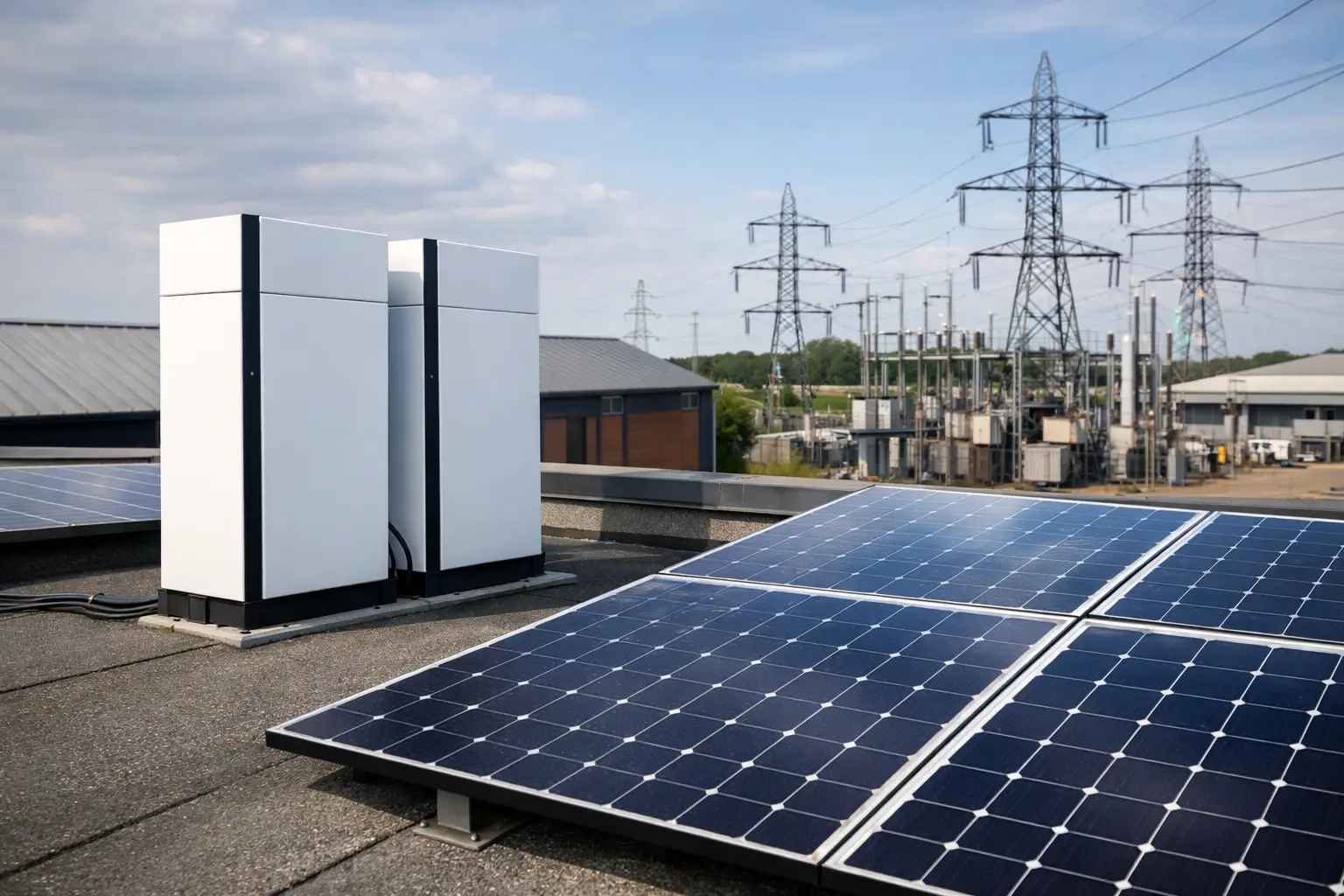
A sunny afternoon can leave a solar property generating more electricity than it can use. The question is what happens next. In the solar battery versus grid export decision, one option stores that surplus for later use, while the other sends it to the network in return for payment. The right choice depends less on a single headline figure and more on how your building uses energy, the tariff available to you, and what you want from your system.
For many homes and businesses, the strongest result is not an either-or choice. It is a well-designed system that uses power on site first, charges a battery when it makes financial sense, and exports only the remaining surplus.
How solar surplus is used
Solar panels generate electricity whenever there is daylight, with the highest production commonly occurring around the middle of the day. That timing does not always match demand. A household may be quiet while occupants are at work, for example, then use more electricity for cooking, lighting and entertainment after sunset. A commercial site may have a better daytime match, but still see peaks in the morning, evening or during specific production processes.
Your solar generation is normally used in this order: power is supplied to active appliances and equipment first; excess electricity can then charge a battery; and any further surplus can be exported to the grid. The priorities can be adjusted depending on the battery, inverter and tariff arrangement, but the principle remains the same: use each kilowatt-hour where it delivers the most value.
Solar battery versus grid export: the financial difference
The key comparison is between the cost of buying electricity from the grid and the payment received for exporting it. In most cases, grid electricity costs considerably more per kilowatt-hour than an export tariff pays. That means using stored solar electricity in the evening can often save more than exporting the same electricity at lunchtime.
Consider a simple example. If exporting a unit of solar power earns 15p, but avoiding a unit of imported electricity saves 30p, storing and using that solar power later appears attractive. However, batteries are not 100% efficient. Some energy is lost during charging and discharging, so a kilowatt-hour generated by the panels does not become a full kilowatt-hour available from the battery.
Battery storage also has an upfront cost and a finite operating life. A fair assessment therefore considers the whole system: purchase price, expected cycling, usable capacity, efficiency, warranty terms, tariff rates and the likely value of electricity avoided over time. The best decision is based on projected annual performance, not a single good-weather day.
When exporting can be the better option
Exporting is not a missed opportunity. It can be sensible where a property already uses most of its solar generation during the day, where battery capacity would sit underused for long periods, or where an attractive export tariff is available.
Some businesses, particularly those with consistent daytime operations, can consume a high proportion of solar power directly. A retail site, office, hotel or food-production facility may have refrigeration, lighting, ventilation or machinery running when panels are generating. In that situation, the battery may be smaller or may have a more specialised role, such as reducing demand at expensive peak times.
Export can also suit properties with limited budget or roof space. Installing solar panels without a battery still reduces imported electricity whenever generation matches demand, while Smart Export Guarantee payments provide an income for surplus electricity sent to the grid. A battery can be added later if the system has been designed with that possibility in mind.
When a battery delivers more value
Battery storage is often most useful where electricity demand rises after solar generation falls. For a typical household, that can mean using stored solar power for the evening routine rather than buying power at the full retail rate. For landlords and residential-block operators, batteries may help improve on-site use of generation across shared supplies, subject to the system design and metering arrangements.
For commercial properties, batteries can help manage more variable demand. A business with sharp evening loads, high electricity prices at particular times or a requirement for closer control of energy use may gain more from storing power than exporting it immediately.
A battery can also be charged from the grid during lower-priced tariff periods and used when prices are higher. This is separate from solar storage but can improve the value of the battery throughout the year, particularly in winter when solar production is lower. It requires the right tariff, controls and operating strategy, rather than simply setting the battery to charge whenever possible.
Backup power is valuable, but it is not automatic
One of the most common assumptions is that every solar battery will keep a property powered during a grid outage. That is not always the case. Many standard solar systems switch off when the grid fails as a safety measure, even if the sun is shining and a battery is installed.
To provide backup, a system needs the appropriate inverter capability, switching equipment and electrical design. The level of backup also matters. Some properties may support selected essential circuits, such as lighting, refrigeration, internet equipment and a few sockets. Others may need a more comprehensive backup design, which can increase cost and complexity.
This is an area where priorities should be agreed before installation. If resilience matters to your household or operation, it should be included in the survey and quotation rather than treated as an assumption after commissioning.
Tariffs can change the calculation
Electricity tariffs are a major part of the solar battery versus grid export calculation. A fixed import tariff and a straightforward export tariff create one set of numbers. Time-of-use tariffs, where import and export prices change across the day, create another.
For example, exporting at a higher rate during a peak period could sometimes be more valuable than charging the battery with solar at that moment. Conversely, charging a battery overnight from a low-cost tariff and using it during a high-cost period may reduce grid purchases even when there is little sunshine.
There is no universal tariff strategy. It should reflect the property’s consumption profile, solar output, battery size and appetite for active energy management. Monitoring data is especially useful here. It shows when electricity is generated, imported, stored and exported, replacing guesswork with evidence.
Battery size matters more than many people expect
A larger battery is not automatically a better battery. If it is oversized for the building’s surplus solar and evening consumption, it may not cycle fully often enough to justify the additional cost. If it is too small, it may fill early in the day and leave excess solar available for export while the property still imports electricity later that evening.
The right capacity should be matched to real usage. A household with modest evening demand needs a different design from a property with electric heating, an EV charger, a heat pump or a large family. Commercial systems need an even closer assessment of half-hourly usage, operational hours, load peaks and future expansion plans.
A professional survey should also consider roof orientation, shading, available installation space, electrical infrastructure and any distribution network requirements. These details affect the practical performance of the whole system, not just the panel output shown in a proposal.
Environmental value and energy independence
Both storage and export support a lower-carbon electricity system. Using solar power directly reduces the need to buy grid electricity at the time it is needed. Exporting makes surplus renewable generation available to the wider network, where it can serve other users.
Battery storage adds greater control. It lets a property carry more of its own clean generation into the evening, reducing dependence on imported electricity and providing a clearer view of where energy is being used. That independence is particularly appealing when electricity prices are uncertain, although it should be understood as reduced reliance on the grid rather than complete off-grid operation.
Choosing the right route for your property
Start with your energy profile, not a preference for a particular piece of equipment. Look at when your building consumes electricity, how much solar generation is likely to be surplus, what your current import tariff costs and what export rates are available. Then consider whether backup capability, future EV charging or business continuity are part of the brief.
For many properties, solar panels paired with a correctly sized battery offer the best route to higher self-consumption and lower imported electricity. For others, particularly sites with strong daytime demand or high export rates, exporting more power may remain the sensible financial choice. A tailored design can preserve both options and set clear priorities as tariffs and energy needs change.
A detailed property survey turns that choice into practical numbers, helping you invest in a system that works for your building long after the first sunny day.